Canon C80 vs. Blackmagic PYXIS 6K: The Same Tradeoff, Different Brands
The C80 and PYXIS 6K sit nearly $2,500 apart. Here's the familiar tradeoff: mature autofocus vs. RAW-native flexibility.

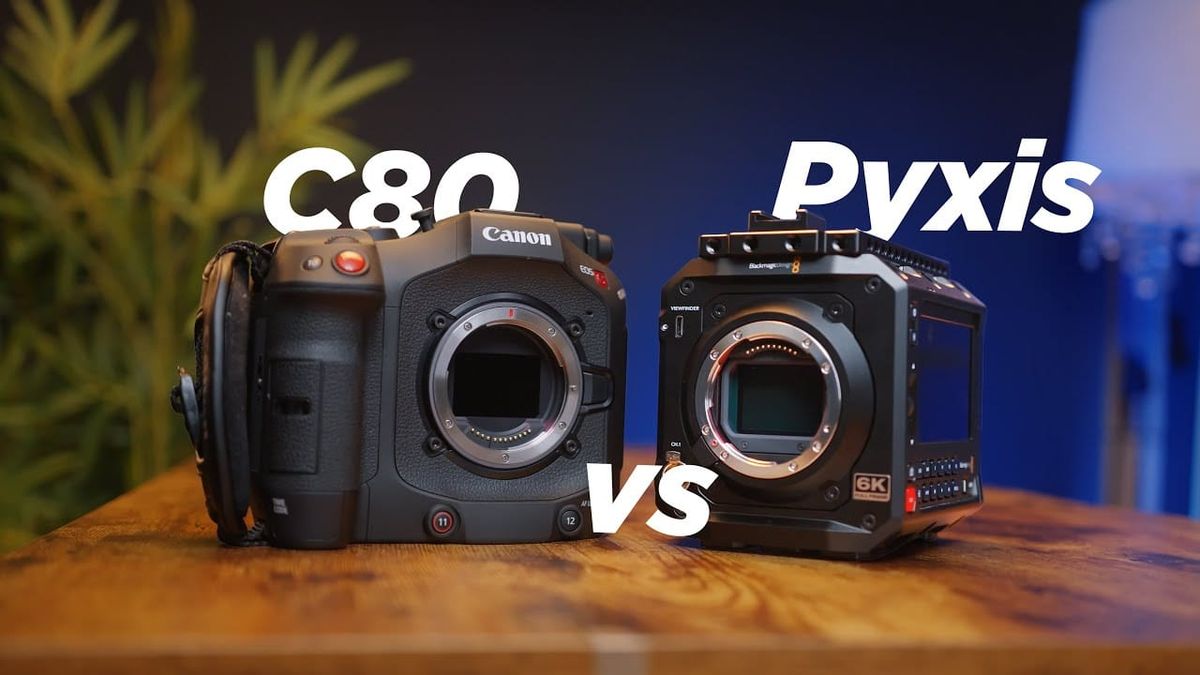
The Canon C80 and Blackmagic PYXIS 6K land in a similar full-frame 6K resolution class, but nearly $2,500 apart in price, and the gap traces back to a familiar tension: Canon's mature autofocus versus Blackmagic's RAW-native, fully modular approach.
Price and What It Buys
The PYXIS 6K starts at $2,995 (L-Mount or EF) or $3,195 (PL-Mount), all fixed at purchase. The C80 runs roughly $5,500, nearly double. That gap isn't really about resolution, both cameras shoot 6K, it's about maturity, autofocus, and how ready-to-shoot each camera is out of the box.
Autofocus Is Still the Clearest Divide
The C80 carries Canon's Dual Pixel CMOS AF II, a mature, well-refined system with years of iteration behind it. The PYXIS 6K only gained phase detect autofocus through a June 2026 firmware update, a real, working feature now, but a first-generation implementation on a camera platform that wasn't originally designed around AI-driven tracking. For solo shooters without a dedicated focus puller, that maturity gap is the single most practical difference between these two cameras.
Dynamic Range and ISO Structure
The C80 claims up to 16 stops of dynamic range with triple base ISO (800, 3200, 12,800), giving it three distinct clean exposure points across its range. The PYXIS 6K claims 13 stops with dual native ISO (400 and 3,200, up to 25,600), a real gap on paper, though real-world grading latitude often narrows that difference more than the raw stop count suggests.
RAW Format and Media Cost
The PYXIS 6K records natively in 12-bit Blackmagic RAW, a format built specifically around DaVinci Resolve's color pipeline and widely regarded as lightweight and editor-friendly. The C80 records 12-bit Cinema RAW Light, Canon's own proprietary format tied to its own ecosystem. Media costs cut in the C80's favor here: it uses SD cards exclusively (V90-rated for RAW), while the PYXIS requires CFexpress, a genuinely pricier card format across the board.
Body and Readiness Out of the Box
The C80 ships with a usable top handle and mounting points already in place, a compact, camcorder-style body ready to shoot with minimal additions. The PYXIS 6K uses Blackmagic's fully modular box design, requiring separate accessories, mounts, and monitoring just to become a usable shooting rig. That's a real cost and setup-time difference beyond the sticker price alone.
Competitive Context
Both cameras are explicitly positioned as accessible entry points into full-frame 6K acquisition, Canon leaning on ecosystem maturity and autofocus, Blackmagic leaning on RAW workflow and price. Neither is chasing the same buyer directly: Canon is selling reliability and a ready-to-shoot body, Blackmagic is selling image flexibility and a genuinely lower price for those willing to build out the rig themselves.
The Signal in the Noise
This is the same underlying tension as the FX5 vs. PYXIS 6K comparison, mature autofocus and a ready-to-shoot body on one side, RAW-native flexibility and a significantly lower price on the other, just replayed with Canon instead of Sony on the premium end. The nearly $2,500 gap is really the cost of that autofocus maturity and out-of-box readiness, not a simple value discrepancy.
Would reliable, mature autofocus and a ready-to-shoot body be worth nearly double the price to you, or does the PYXIS 6K's RAW workflow and lower cost of entry win out?
The Details
- Canon EOS C80: ~$5,500, 6K full-frame BSI stacked sensor, triple base ISO (800/3200/12,800), 16 stops dynamic range, Dual Pixel CMOS AF II, dual SD card slots (V90 for RAW), 12-bit Cinema RAW Light, ready-to-shoot compact body
- Blackmagic PYXIS 6K: $2,995 (L-Mount/EF) / $3,195 (PL-Mount), 36x24mm 6K full-frame sensor, 13 stops dynamic range, dual native ISO (400/3,200), phase detect autofocus added via Camera 10.2 firmware (June 2026), 12-bit Blackmagic RAW, dual CFexpress slots, fully modular box body