How Many Stops of ND Do You Need for Video? A Table by Aperture and ISO
How many stops of ND does daylight video need? This table gives the answer by aperture and base ISO at a 180-degree shutter, plus adjustments for weather and frame rate.


Full sun at f/2.8 can need six to nine stops of ND for video, depending on base ISO. The table below shows how many stops each aperture and base ISO needs at a 180-degree shutter.
The numbers come from the Sunny 16 rule and a 1/48 s shutter at 24 fps. Treat them as a starting point, then adjust with your meter or false color.
ND Stops Needed in Full Sun at 24 fps
| Aperture | ISO 100 | ISO 400 | ISO 800 |
|---|---|---|---|
| f/11 | 2 | 4 | 5 |
| f/8 | 3 | 5 | 6 |
| f/5.6 | 4 | 6 | 7 |
| f/4 | 5 | 7 | 8 |
| f/2.8 | 6 | 8 | 9 |
| f/2 | 7 | 9 | 10 |
| f/1.4 | 8 | 10 | 11 |
Read across a row for your base ISO. At f/2.8 and ISO 800, the table says 9 stops.
Stops convert to ND numbers by doubling. Three stops is ND8 (0.9), six is ND64 (1.8), nine is ND512 (2.7), and ten is ND1000 (3.0).
How the Numbers Work
The baseline is Sunny 16: at f/16 and ISO 100, bright sun calls for about 1/100 s. A 1/48 s shutter admits a bit over a stop more light, so f/16 needs about one stop of ND.
Every full stop wider on the aperture adds one stop of ND, and every doubling of ISO adds another. That is why cameras with a higher base ISO, such as 800, need so much more ND.
Adjusting for Light and Frame Rate

Sunny 16 has the usual weather steps. Slight overcast is one stop darker, overcast two, and heavy overcast three. Subtract one stop of ND for each step.
At 25 fps with a 180-degree shutter (1/50 s), the table holds. At 30 fps (1/60 s), subtract about a third of a stop. At 60 fps (1/120 s), subtract about one stop and a third.
Each halving of the shutter angle means one stop less ND. Each doubling means one stop more.
What a Variable ND Covers
NiSi USA lists its variable NDs at 1 to 5 stops, 1.5 to 5 stops, and 5 to 9 stops. It also sells a SWIFT kit that pairs a 1 to 5 stop VND with a 4-stop ND for a 1 to 9 range.
Compare that with the table. A 1 to 5 stop VND covers f/5.6 at ISO 100, which needs 4 stops, but falls short at f/2.8, which needs 6. At ISO 800, f/8 already needs 6.
For wide apertures in daylight, that means a bigger variable range or a fixed ND stacked with a 1 to 5 stop VND.
Competitive Context

Most ND charts are written for stills. B&H's guide, for example, converts stops to ND numbers and long exposure times, such as smoothing a waterfall.
Shutter-angle explainers often cover the other half: converting angle to shutter speed at a given frame rate. This table combines the two, starting from the video shutter and ending at an ND number.
The Signal in the Noise
The table is a starting point, not a measurement. Sunny 16 assumes bright sun with distinct shadows, and real scenes vary by a stop or more.
Meter or check false color, then add or remove ND in half stops. A variable ND makes that easy.
Variable NDs can also show an X pattern at high density on wide lenses. NiSi recommends focal lengths of 35 mm and longer for its VND-only filter.
A polarizer adds its own light loss, so a combo filter can darken more than its scale says. NiSi does not state that loss for its VND/PL.
What is your daylight ND setup: a variable, fixed filters, or built-in ND?
Specs & Pricing
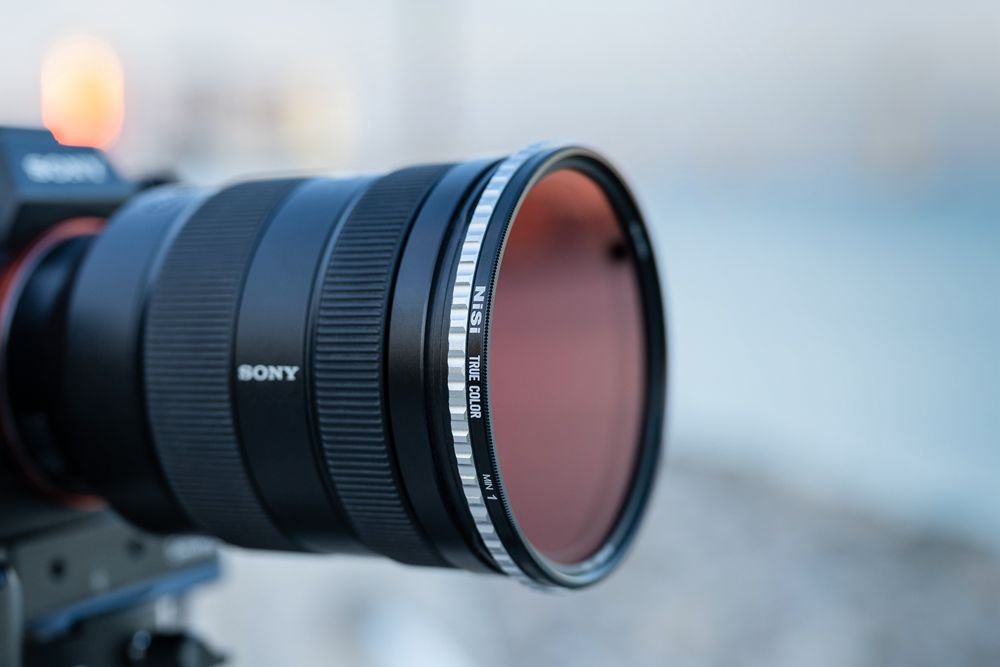
- NiSi True Color VND, 1 to 5 stops, 77 mm: $225
- NiSi True Color VND/PL, 1 to 5 stops, 77 mm: $229
- NiSi SWIFT True Color VND Kit, 1 to 9 stops, 77 mm: $309
- These are NiSi USA list prices. Exact pricing is available on NiSi's website.