The Higgsfield TOS Controversy, Explained: What Happened, What Changed, and What's Still Worth Watching
Higgsfield updated its Terms of Service on July 23, creators pushed back hard, and the company revised them again. Here's the full story — what the original terms actually said, what changed, and what's still worth knowing before you build a commercial workflow on the platform.

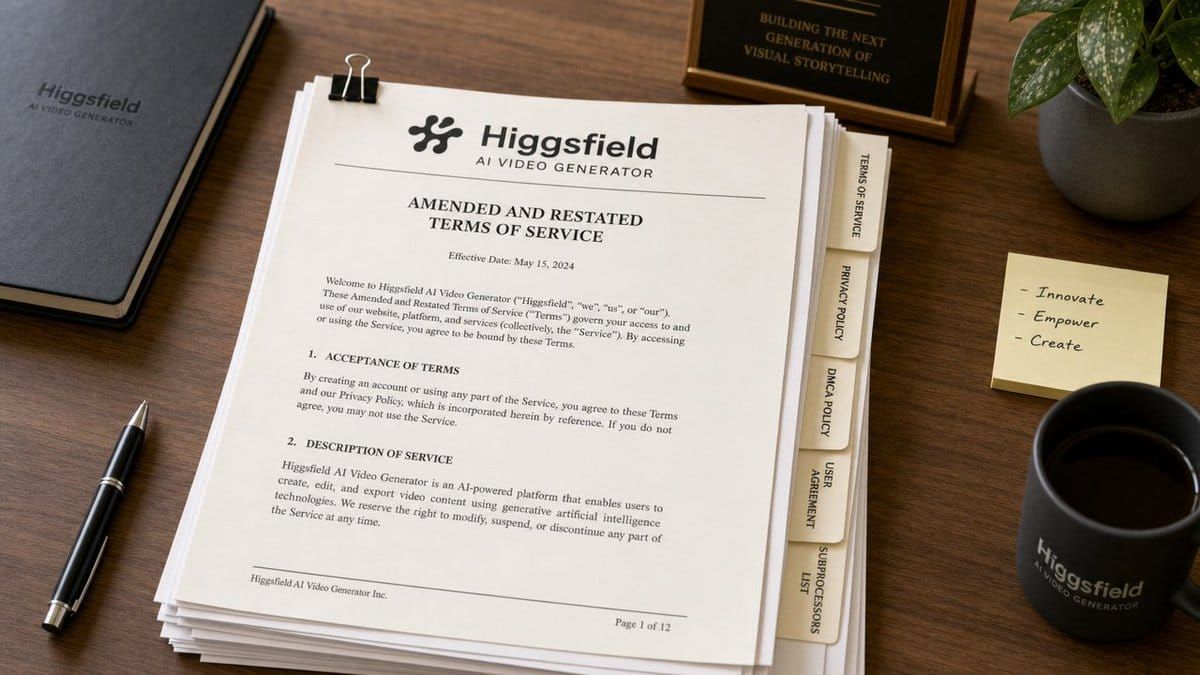
If you've been seeing Higgsfield discourse all over your feed this week and aren't sure what to make of it, here's the full picture — including what the original terms actually said, what the community pushed back on, what Higgsfield changed, and what independent analysis says is still worth knowing before you build a commercial workflow on the platform.
What Higgsfield is, briefly
Higgsfield is an AI video and image generation platform that aggregates multiple models — Seedance, Kling, Veo, Nano Banana, Sora 2, and others — into one dashboard, similar to what Runway's multi-model marketplace is doing. Users pay Higgsfield rather than subscribing to each model separately. The platform launched as a creator-focused all-in-one AI video tool and has grown a significant following among AI filmmakers and content creators.
This isn't Higgsfield's first public controversy. In February 2026, the company's X account was suspended after widespread complaints — including reports of "unlimited" plans that throttled heavily, creator program payments that were difficult to withdraw, and accounts banned without warning. Higgsfield said fraud had surged and that 90% of submissions had been paid; X said the account violated its rules. The company recovered from that episode but the creator trust deficit carried forward.
What happened on July 23
On July 23, 2026, Higgsfield published a terms of service update. The update was intended to cover new products — the Supercomputer Agent and MCP developer access — that had launched without updated terms. What it also did was carry forward legacy language from 2025 that, when read carefully, created significant concerns.
The specific language that triggered the backlash:
The original update included what legal analysts described as a "perpetual, irrevocable" license — meaning Higgsfield could retain the right to use your content even after you deleted it. The sublicensing language allowed content to travel "through multiple tiers" to unnamed third parties. Private work had unclear protection from promotional use.
And the 15-day advance notice period for future terms changes was removed entirely, replaced with undefined "reasonable advance notice" — which, as @TheoMediaAI put it in his detailed thread, effectively meant the clause governing this exact kind of episode got vaguer right after it happened.
@TheoMediaAI — whose thread became the most comprehensive independent analysis of the changes — identified seven significant takebacks in the updated terms, three of them major: the perpetual license language, the removal of the 15-day notice floor, and the removal of the 15-day API breaking-change notice for developers.
The response: competitor pile-on and community pressure
Go read Higgsfield's terms of service. They can use your uploads and your generations in their marketing, in other people's outputs, and send it to third parties. Even after you delete your account, they keep it.
— Invideo (@invideoOfficial) July 24, 2026
At invideo, we don't train on your data. Period. pic.twitter.com/oiEmNlbnRA
InVideo's official account posted a thread calling the situation a case of creators having their information "STOLEN" — heated language that most legal observers considered an overclaim, but which was effective at amplifying the backlash. The thread went viral at 575K views and framed the controversy as a clear-cut Higgsfield versus InVideo choice, with InVideo positioning its own no-training, no-affiliate-clause policy as the alternative.
That framing is worth holding at arm's length. InVideo is a direct competitor, and its thread was structured as a comparison ad more than a neutral analysis. The actual situation was more nuanced than "your information is being stolen" suggests.
More substantive criticism came from working filmmakers and developers, including @MichaelRyanHahn, who raised the central practical concern: "Imagine being halfway through creating a film and the rights change (again). That isn't workable. What can you do beyond saying some version of 'trust me, bro' to fix this?"
That's the real question the controversy surfaced, and it's one that TOS language changes alone can't fully answer.
What Higgsfield did next
 Higgsfield.AI Team
Higgsfield responded quickly and directly, engaging with critics individually on X and committing to a full revision before August 7 — the date the original July 23 update was set to become binding for existing users. The company also clarified several points in writing: private content stays private, the license to content ends when you delete your account, and the July 23 update does not apply to existing users until they see and accept the final revised text.
At 3:37am on Sunday, July 26 — this morning — @TheoMediaAI received the revised T&C and Privacy Policy and posted his follow-up analysis. His scorecard: community won eight significant changes, Higgsfield walked back three major and one minor takebacks, but seven other changes remain worth noting.
What the revised terms actually fixed (the wins)
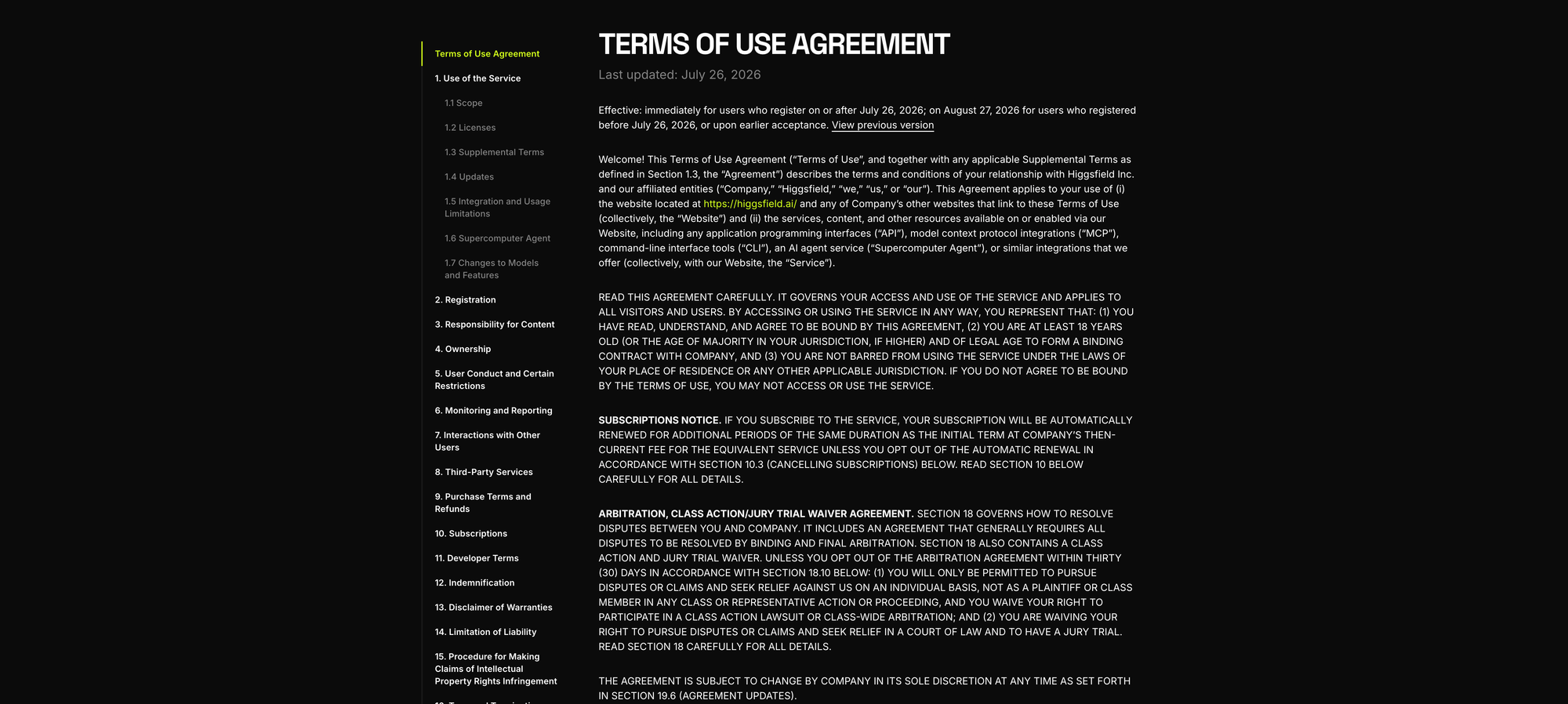
According to @TheoMediaAI's analysis, the community's pushback produced eight meaningful wins in the revised terms:
The "perpetual, irrevocable" license language is gone. The license now ends when you delete your content or account. Content sublicensing is narrowed to service providers only. Private work is expressly protected from promotional use — Higgsfield's marketing can only use content you've made public yourself (community page, contests) or given explicit consent for. Client work in private workspaces is specifically covered.
The deletion carve-out got more honest: the blank-check "incorporated into models" language is replaced with a real commitment that going forward, they won't use deleted content to train. Indemnity is now fault-based — you cover their legal bills only if you lacked rights or broke rules, not for anything the model does on its own.
"Sole discretion" language for moderation and bans is replaced with a "reasonable" standard. Exported content rights survive account deletion. And the throttle trigger for "unlimited" plans got more specific — the new language requires proof of automated or materially excessive use rather than whatever Higgsfield previously determined.
What's still worth knowing
Higgsfield just sent out a new Terms and Conditions & Privacy Policy Agreement. I know most people just sign off on those without ever looking-- but, here's some stuff you should know.
— Theoretically Media (@TheoMediaAI) July 24, 2026
Read to the bottom before you "Bro" me. pic.twitter.com/EynW6aLsuS
@TheoMediaAI identified seven remaining items worth knowing, despite the improvements:
Training is still on by default for everyone (§4.4). The training sentence is unchanged from July 23. There's no toggle, no consent screen. The only way to opt out of training is to delete your content or your account. Enterprise customers get contractual no-training and confidential handling — consumer and solo creator accounts train the model; companies that pay more don't.
The 15-day notice floor for terms changes is still gone. It's now "reasonable advance notice," which is undefined.
The Privacy Policy became part of the contract (§1.1) — using the service now means consenting to every data practice in the privacy policy, with privacy disputes pulled toward arbitration with a $100 cap.
The API breaking-change notice for developers is still deleted (§11.10) — developers who had a 15-day contractual warning now have zero.
Contest entries can be shared with unnamed "promotional partners" (§4.7 + Privacy §4), with contest fine print able to override the main terms.
Unset sharing settings "may default to the most permissive setting" (§3.2) — and public is exactly what's promo-eligible.
Running your account through an LLC or selling your business now automatically voids your account (§19.2).
The broader context: this isn't just a Higgsfield problem
Startup Fortune's analysis placed the Higgsfield situation in useful industry context: its terms are not dramatically outside what other AI video platforms offer. Kling AI is the notable outlier — its terms explicitly allow users to revoke training authorization by emailing a specific address, which gives creators a lever that Higgsfield, Runway, and Pika's consumer-tier terms don't offer.
That's the real lesson underneath the Higgsfield TOS controversy. The specific terms matter less than the category of question: if you're generating content for a client, working with unreleased footage, or producing anything tied to an NDA, the training license question is not theoretical. It determines whether today's private creative work becomes tomorrow's model improvement. That's a question worth asking before you build a commercial workflow on any AI video tool — not after a controversy forces the issue.
Where things stand right now
I’m pretty disappointed to see some AI creators here on X post and repost about Higgsfield’s TOS update when it made the company look bad, but then stay silent after Higgsfield responded and addressed the concerns.
— JSFILMZ (@JSFILMZ0412) July 26, 2026
If you're going to amplify criticism, it's only fair to share… https://t.co/bILHe2LPkI pic.twitter.com/FiNKSMNS71
Higgsfield has committed to publishing the fully revised Terms of Use before August 7, 2026, with a blog post outlining key changes. Nothing from the July 23 update applies to existing users before that date. The final text will be visible before it becomes binding.
Whether those final terms close the remaining gaps — particularly the default-on training, the undefined notice period for future changes, and the contest side door — is what the August 7 document will answer.
The bottom line
The community pushed back and won meaningful changes. The revised terms are materially better than what was published July 23. Training on consumer accounts by default remains on, and several structural concerns identified by @TheoMediaAI survive the revision. Higgsfield's history — the February X suspension, the payment complaints, the "unlimited" plan throttling — means trust here is earned over time, not via a single terms revision, however improved.
If you use Higgsfield for personal or low-stakes creative work: the revised terms appear reasonable. If you're building a commercial workflow, handling client work, or generating content tied to NDAs: read the final August 7 terms carefully, keep client work in private workspaces, and consider whether an enterprise agreement — which includes no-training and confidential handling — is warranted for your use case.