What Panasonic's Record Profit Actually Says About the Future of LUMIX
Panasonic posted its best quarter since 1985, driven by AI data centers, while LUMIX sits in the one division that shrank.


Panasonic just posted its highest first-quarter operating profit since 1985, and the company now expects its first record annual profit in 42 years. LUMIX isn't mentioned once in the entire earnings report, and the division it lives in was the only one that shrank.
The Numbers Behind the Record
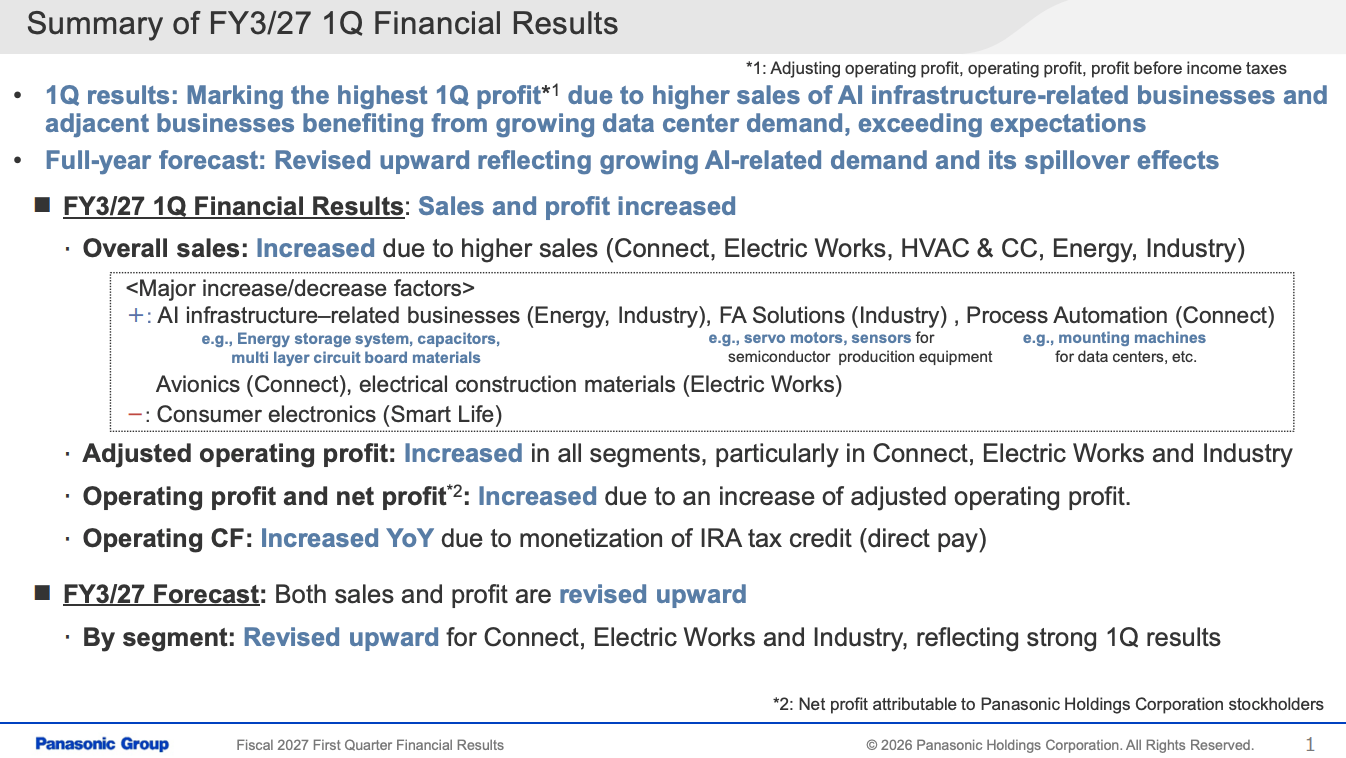
Panasonic's group sales rose 6.4% year over year to ¥2,018.9 billion (around $12.8 billion) for April through June 2026, with operating profit jumping 110% to ¥182.5 billion (around $1.2 billion), a figure that broke a record standing since 1985. The company raised its full-year forecast to ¥7,800 billion (around $49 billion) in sales, which would beat its all-time annual profit record set in fiscal 1984.
The driver isn't cameras, TVs, or appliances. It's AI infrastructure. Panasonic's energy storage systems for AI data centers posted quarterly sales of ¥113.0 billion (around $720 million), nearly double the prior year. Its AI-related capacitors and circuit board materials for server hardware grew 1.4 times to ¥74.9 billion (around $470 million). Even the machines Panasonic sells for mounting components onto circuit boards are moving faster, driven by AI server manufacturers.
Where LUMIX Actually Sits
Panasonic doesn't report camera-specific sales or profit at all. LUMIX lives inside the Imaging Solution Business Division, which sits inside AVC (alongside TVs and communication networks), which itself is part of the broader Smart Life segment, the same segment that includes refrigerators, washing machines, and hairdryers.
Smart Life was the only Panasonic segment to post a sales decline this quarter, down 8% excluding currency effects to ¥311.1 billion (around $2.0 billion). Within that, AVC specifically fell from ¥84.8 billion to ¥73.1 billion (around $540 million to $460 million), a drop of nearly 14%, which Panasonic attributes to weaker sales in Europe and China. Segment profit ticked up slightly to ¥12.2 billion (around $77 million), but the report credits restructuring and cost-cutting for that gain, not product demand.
Competitive Context

Panasonic's results land in the middle of a mixed earnings season across the camera industry. Canon and Sony both posted strong results this quarter, Sony's raised outlook driven partly by its image sensor business, while Nikon cut its camera forecast on weak China demand and rising memory costs. Panasonic is unusual in this group: its overall business is thriving, but the specific unit housing its cameras is the one part of the company moving in the wrong direction, and it's being managed for efficiency rather than growth.
There's a real irony sitting underneath this too. The same AI data-center boom generating Panasonic's record profits is also driving the global memory shortage that's been raising component prices across the camera industry, including Panasonic's own AVC unit. Panasonic named memory specifically, alongside copper and resin, as a factor behind a projected ¥191.0 billion (around $1.2 billion) full-year raw material cost headwind, up sharply from its earlier forecast. The company is profiting from one side of the AI boom while absorbing its costs on the other.
The Signal in the Noise

None of this reflects poorly on LUMIX as a product line. The S1II has been quite popular, the affordable L10 sold out shortly after launch, and Panasonic's leadership has spoken openly about cinema-camera ambitions and multi-mount commitment.
But a division that doesn't get its own line item in a record-breaking earnings report, sitting inside the one segment that shrank, is not where a company's capital attention is currently pointed. Nothing here forces cuts. A parent company posting its best profit in four decades has no financial pressure to touch anything. The open question is whether any of that AI windfall flows back into camera development, or whether LUMIX simply keeps earning its place quarter by quarter on product strength alone.
Does a camera division succeeding financially while riding inside a much larger, faster-growing company change how you think about its long-term product roadmap?
Specs & Pricing
- Panasonic Q1 FY2026 (Apr–Jun 2026) group sales: ¥2,018.9B (~$12.8B), up 6.4% YoY
- Operating profit: ¥182.5B (~$1.2B), up 110% YoY, highest since 1985
- Full-year forecast: ¥7,800B (~$49B) sales, ¥590B (~$3.7B) operating profit
- AI data center energy storage sales: ¥113.0B (~$720M), 1.9x YoY
- Smart Life segment (includes LUMIX): only segment with declining sales, down 8% YoY
- AVC unit (includes LUMIX): ¥73.1B (~$460M), down nearly 14% YoY
- Projected full-year raw material cost headwind: ¥191.0B (~$1.2B), including memory prices