Insta360 Enters the Gimbal Camera Market with Leica-Engineered Luna Ultra

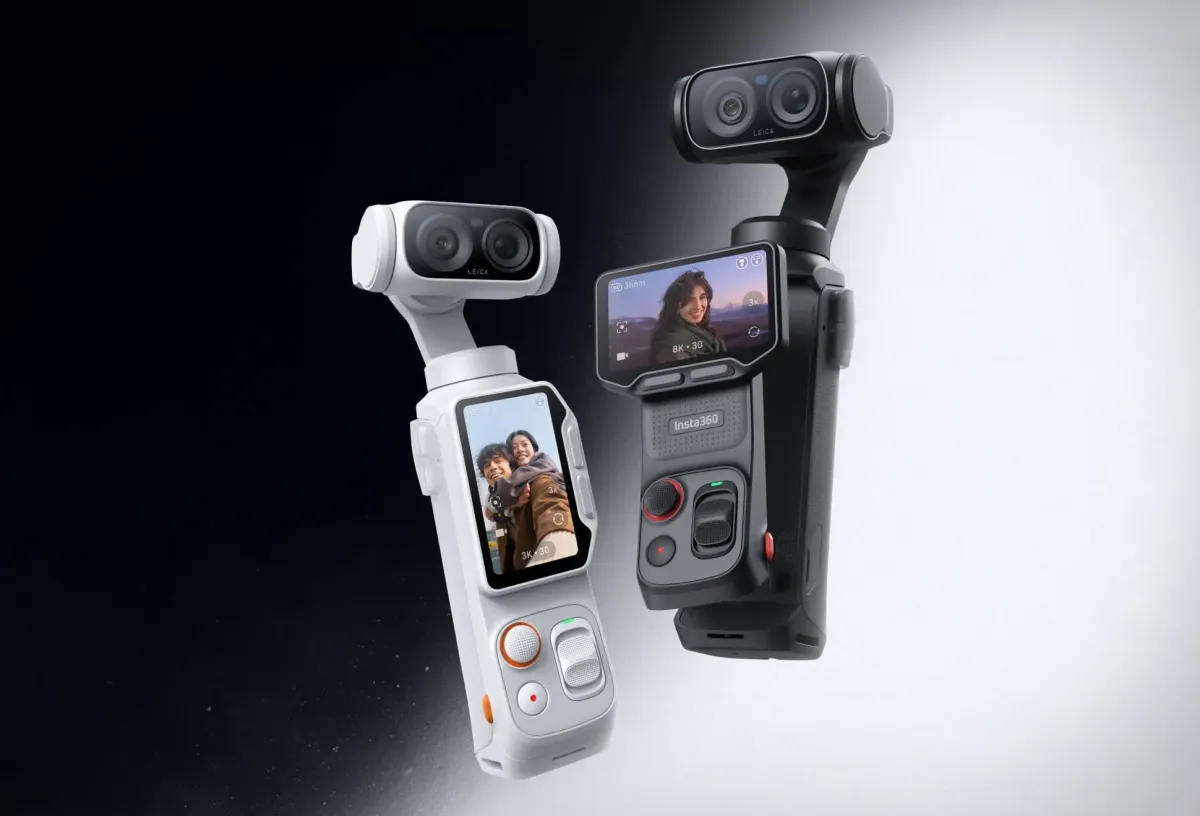
Insta360 launched the Luna Ultra on June 10, 2026 — its first entry into the compact gimbal camera category — at $769.99 (USD). Co-engineered with Leica and unveiled at Leica's headquarters in Wetzlar, Germany, the camera targets mobile filmmakers and video creators with a dual-lens system, 8K video, and a detachable OLED touchscreen remote. It is available now through the Insta360 Store, Amazon, Best Buy, and select retailers.
What the Luna Ultra Is
The Luna Ultra is built around a 1-inch sensor paired with a Leica Summicron lens at a 20mm equivalent focal length and f/1.8 aperture, alongside a secondary telephoto camera using a 1/1.3-inch sensor at 60mm equivalent and f/2.0. The telephoto system offers 3x optical zoom, 6x lossless zoom, and 12x digital zoom. The camera records video at up to 8K/30fps with Dolby Vision HDR and 10-bit I-Log, and captures 14 stops of dynamic range. Still photography tops out at 37-megapixel UltraPhotos and 200-megapixel panoramas.
Stabilization combines a three-axis mechanical gimbal with electronic image stabilization. Insta360's Deep Track 5.0 powers AI subject tracking, including Auto Tracking, Active Zoom Tracking, Group Tracking, and Smart Framing. The camera embeds timecode directly into recorded footage to simplify multi-camera synchronization.
The standout hardware feature is a detachable 2-inch OLED touchscreen that also functions as a wireless remote, enabling framing and recording control from up to 20 meters away. The unit ships with 47GB of built-in storage and supports microSD cards up to 1TB. A 1,550mAh battery is rated for up to four hours of shooting, with 0-to-80% fast charging in approximately 23 minutes. Insta360 also confirmed a base single-lens Luna Pro model is expected within the next month.
Competitive Context
The Luna Ultra enters a category defined by DJI. The DJI Osmo Pocket 4 — currently unavailable in the US due to ongoing regulatory challenges — and the forthcoming Osmo Pocket 4P represent the direct competition. The Pocket 4P is also a dual-lens gimbal system, though it is positioned around 6K/60fps video, a variable aperture lens, and 17 stops of dynamic range, running in a more compact form factor. The Luna Ultra counters with higher maximum resolution, Leica optics, and the detachable remote — a feature not present in any current Pocket model.
DJI's US distribution uncertainty creates a window for Insta360. The Luna Ultra is available at major US retailers immediately, while the Pocket 4P has not yet launched. Insta360 is also building out a dedicated accessory ecosystem for Luna, including a POV Head Tracker, Wide-Angle Lens, and Black Mist and ND filters.
The Signal in the Noise
The gimbal camera category has been a DJI monoculture for years. The Pocket series built a loyal following among solo shooters, vloggers, and run-and-gun documentary filmmakers precisely because it required minimal setup and delivered reliable stabilization. Insta360 is not trying to copy that formula — it is adding hardware modularity and Leica's optical credibility on top of it.
The detachable OLED remote is the feature worth watching. For solo operators shooting interviews, narrative pieces, or event coverage, the ability to monitor and control a stabilized camera from 20 meters away without a separate operator changes the practical math of a one-person shoot. That is a workflow problem DJI has not solved at this price point.
The 10-bit I-Log and timecode embedding matter too. These are not consumer features — they are signals that Insta360 is positioning Luna Ultra inside professional workflows, not just alongside them. At $769.99 (USD), the camera sits at a price where working shooters make real purchasing decisions. How it performs in actual field conditions will determine whether it holds that positioning or gets commoditized back into the creator-gadget tier.