MiniMax Open-Sourced H3 for Local AI Video, but Not Everyone Can Actually Use It
MiniMax open-sourced H3's weights, and the community got it running on a $280 GPU in 48 hours. But the license excludes the US, EU, UK, and South Korea. Here's what's actually true.

MiniMax open-sourced the weights for its H3 video model on August 3, and within 48 hours the community had it running on hardware nobody expected, gaming GPUs, fully offline MacBooks, and tooling MiniMax says it never planned for. It's a genuinely impressive open-source moment. It also comes with a licensing detail that most of the viral posts circulating this week aren't mentioning.
What Actually Shipped
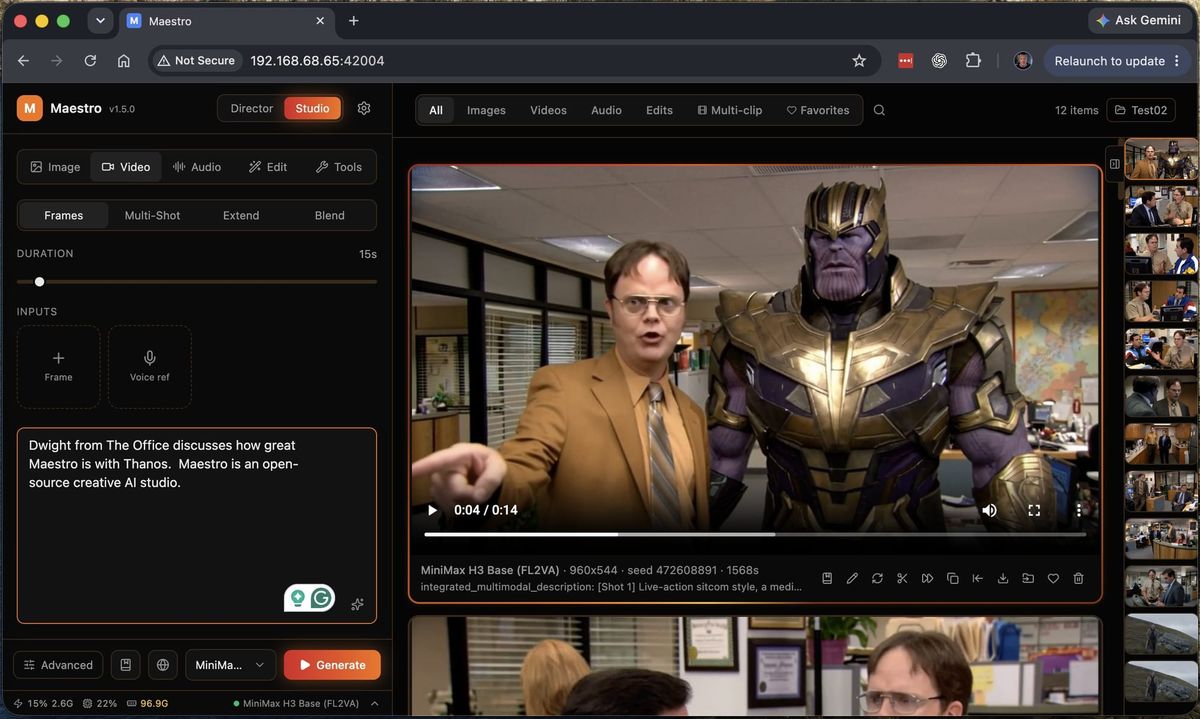
Maestro v1.5.5 with MiniMax H3 is out! 🩵
— MiniMax (official) (@MiniMax_AI) August 4, 2026
The community got H3 running on hardware we never tested - from a gaming GPU to MacBooks running fully offline - and built tooling we didn't plan for within 48 hours.
We're genuinely glad we opened it up. <3 https://t.co/cxmLlgEkcz pic.twitter.com/3I7khZcbnU
H3 launched as a hosted API on July 31, and MiniMax followed it three days later by publishing the model's weights on Hugging Face, with native ComfyUI support merged the same day. That's a real commitment to openness, day-zero support is unusual and meant creators could start building immediately rather than waiting weeks for community integration.
The engineering behind making it actually usable on consumer hardware is legitimate and worth understanding. H3 is a 33-billion-parameter model, and in full precision it runs about 123.6GB, well beyond what any consumer GPU can handle. ComfyUI's team found that roughly 40% of the model's parameters, its modulation weights, could be pruned and replaced with a functionally equivalent lookup table with no loss in output quality, combined with int8 quantization and dynamic VRAM offloading. The result: a footprint reduced by about two-thirds, down to roughly 42.5GB, small enough that the ComfyUI team says a 12GB card, including something like a $280 RTX 3060, can run it with offloading.
The Community Response Was Real
Running MiniMax H3 locally for FREE is blowing my mind!
— Blaine Brown (@blizaine) August 4, 2026
It's like having an unrestricted Seedance2.0/Sora2-level model you can run locally for FREE. https://t.co/KDSJlLMs9r pic.twitter.com/dmqXrv8z6r
The viral post driving a lot of this week's attention, from creator Blaine Brown, showed a locally-generated clip using Maestro, a third-party open-source app built on H3's weights, running entirely offline with no cloud dependency. That's a genuine demonstration, not exaggerated marketing.
Within 48 hours of the weights landing, the community had built one-click installers, custom prompt enhancers, LoRA training pipelines, and speed optimizations claiming 20-35% generation improvements on consumer cards. MiniMax's own team responded publicly, saying they were "genuinely glad" they opened it up.
What "Unrestricted" Actually Means, and Doesn't
This can speed up your Minimax H3 gens by 20-30%https://t.co/D6cds8ZTtk
— ⚡AI Search⚡ (@aisearchio) August 4, 2026
Full tutorial coming tonight! pic.twitter.com/V17CfTtO5G
Framing this as "an unrestricted Seedance2.0/Sora2-level model you can run locally for FREE," as the viral post put it, is accurate in one specific sense and misleading in another. Running locally does mean no cloud-side content moderation gets applied, since nothing routes through MiniMax's hosted API. That's genuinely different from a hosted service.
It does not mean no restrictions apply. The MiniMax H3 Community License explicitly excludes the United States, European Union, United Kingdom, and Republic of Korea from its defined "Applicable Territory." Anyone in those regions needs separate authorization directly from MiniMax to use the weights, full stop. Given that BRC's audience is largely US-based, that's the single most important detail in this entire story, and it's the detail most of the excitement online isn't mentioning.
Local Isn't the Same as the Hosted Product
We just dropped SOTA open weights for our MiniMax‑H3 video model, and so much happened in 48 hours.
— RyanLee (@RyanLeeMiniMax) August 5, 2026
The community ran H3 on untested hardware ($280 gaming GPUs, fully‑offline MacBooks) and built brand‑new unplanned tooling.
Extremely glad we open‑sourced the weights.
Community… pic.twitter.com/iYe4ILK80q
Worth being precise about capability too, since "runs on a 3060" has been getting repeated as though it's equivalent to the full hosted experience. The local open-weight version caps out around 768 pixels on the short edge; MiniMax's official 2K regeneration stage remains hosted-only and isn't part of the open release. Quantized builds running on consumer GPUs are meaningfully more limited than the full-precision research checkpoint, and even the optimized local path reportedly wants around 64GB of system RAM to support the VRAM offloading, plus real patience for render times on lower-end cards.
The hosted API remains the more complete way to actually evaluate H3's real output quality before investing time in a local setup, at roughly $1.20 for a 15-second clip at 768p or $1.95 at 2K.
Competitive Context
Open-weight video models remain rare in a field still dominated by closed, hosted platforms, Runway, Kling, Veo, Seedance. MiniMax choosing to open-source H3 at all, with real day-zero tooling support, is a genuinely different strategy than most major AI video labs are taking right now, and it's a meaningful data point in the broader model-versus-wrapper landscape this beat has been tracking.
But the territorial licensing restriction is a reminder that "open weights" and "open license" aren't the same thing, and the terms are worth reading directly before assuming a release applies to you.
The Signal in the Noise
The technical achievement here is real: getting a 33B-parameter, multimodal video model down to something a $280 consumer GPU can run, in 48 hours of community effort, is genuinely impressive engineering, both from MiniMax and from the open-source community responding to it.
But treating this as a free-for-all, no-restrictions release, especially for anyone in the US, EU, UK, or South Korea, skips over the actual license terms MiniMax published alongside the weights. Read the license before building anything on this, not just the viral clip.