YouTube Adds Auto-Detection to AI Label System in May 2026 Update
YouTube is rolling out automatic AI content detection and more prominent label placement for photorealistic and AI-generated videos, announced May 2026.

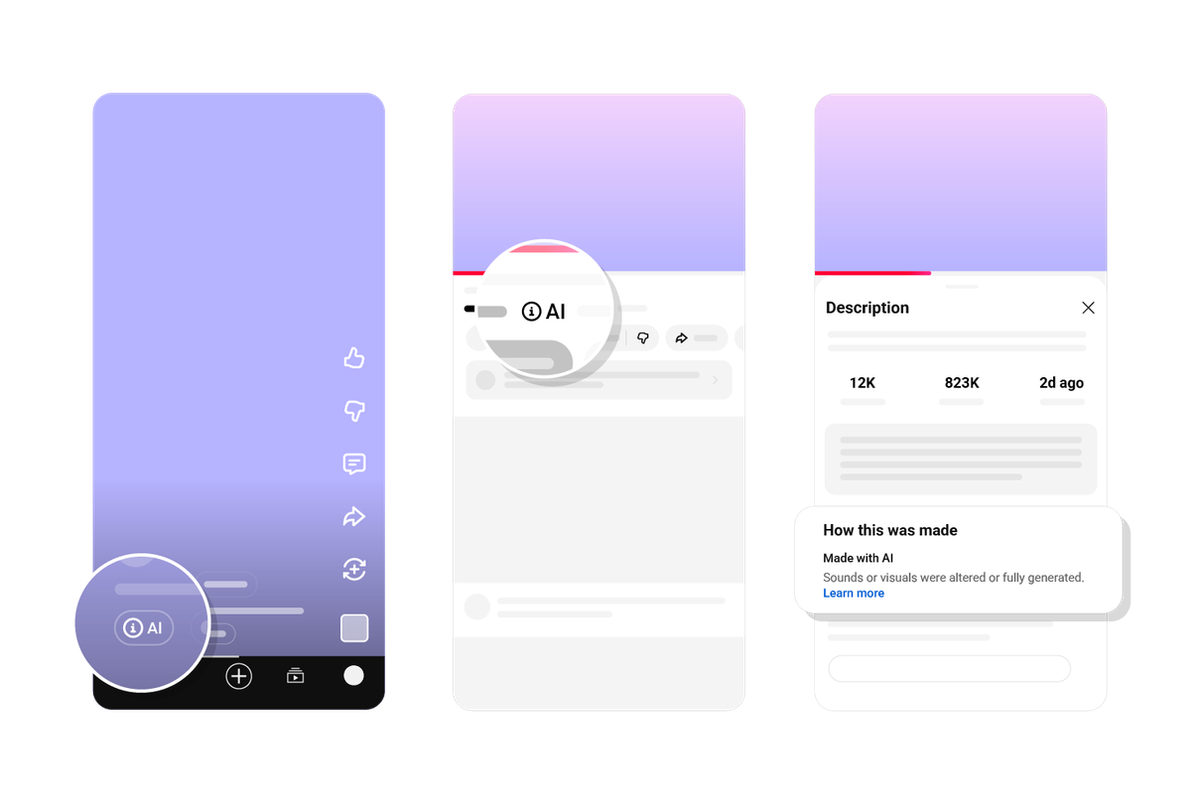
YouTube announced in late May 2026 that it is moving AI disclosure labels to more prominent on-screen positions and introducing automatic detection that can apply labels to photorealistic AI-generated content even when a creator has not self-disclosed. The update applies to long-form videos and Shorts and represents the most substantial revision to the platform's AI transparency framework since mandatory disclosure requirements took effect in May 2025.
What Changed: Label Placement and Automatic Detection
Under the previous system, AI disclosure labels appeared in the expanded description section of a video — a location that required viewers to actively tap or click to reveal. Starting with this update, photorealistic and meaningfully AI-altered or generated content will carry a label below the video player, above the description, on long-form videos. On Shorts, the label will appear as a direct overlay on the video. Content that is unrealistic, animated, or only slightly altered still surfaces its disclosure in the expanded description.
The second and more consequential change is automatic detection. If a creator does not indicate whether AI was used, but YouTube's internal signals identify significant photorealistic AI use, the platform will apply a label without creator input. Creators retain the ability to contest an automatic label through YouTube Studio if they believe their content was misclassified. In certain cases, labels are non-removable: content made with YouTube's own AI tools — including Veo and Dream Screen — and content carrying C2PA metadata indicating fully generative AI origin will always display a label. Content generated through Gemini Omni remixing tools automatically receives both SynthID and C2PA watermarks, making creator opt-out unavailable.
YouTube's disclosure requirements cover content that makes a real person appear to say or do something they did not do, that alters footage of an actual event or place in a way a viewer could mistake as real, or that generates a realistic-looking scene that did not occur. Disclosures are not required for AI used in production workflows — writing scripts, generating captions, or developing content ideas — nor for synthetic media that is clearly unrealistic or involves only inconsequential changes. YouTube has also stated that carrying an AI label does not, on its own, affect a video's recommendation eligibility or monetization status. Persistent non-disclosure, however, can result in manual label application, content removal, or suspension from the YouTube Partner Program.
Rene Ritchie, YouTube's head of editorial and creator liaison, summarized the intent: "The goal here is context at a glance. If it looks real but was made with AI, viewers will know immediately."
Competitive Context
YouTube's move to automatic detection follows a pattern established by other major platforms in 2025. TikTok integrated C2PA Content Credentials in January 2025 and now runs three parallel detection layers — including AI classifiers for synthetic faces and backgrounds — having tagged more than 1.3 billion videos through that system. TikTok carries the broadest mandate among major platforms, requiring disclosure for all significantly AI-modified content, with removal rates for synthetic media up 340% year over year. Meta has applied automatic "AI info" labels to ads created with its generative AI tools since February 2025, with the label appearing alongside the standard "Sponsored" indicator and given added prominence when photorealistic AI-generated humans appear in the creative.
The broader industry direction through 2025 and into 2026 has shifted from a model where disclosure is creator-initiated to one where platform-side detection serves as the primary enforcement mechanism. Regulatory pressure is also a factor: EU AI Act Article 50, which mandates machine-readable content marking for AI-generated material, takes effect August 2, 2026, giving platforms operating in European markets a structural reason to build detection infrastructure now rather than rely solely on creator compliance.
The Signal in the Noise
For filmmakers and video producers distributing work on YouTube, the practical implication is that the disclosure decision is no longer entirely theirs to make. Automatic detection means a label may appear on photorealistic AI-assisted content regardless of whether a creator intended to disclose. Producers integrating AI-generated or AI-composited elements into otherwise live-action work should expect that YouTube's classifiers will flag those elements, and should evaluate in advance whether to proactively disclose or risk an automatically applied label that cannot be reviewed before publication.
The non-removable label category carries specific weight for production companies considering YouTube's own generative tools. Using Veo, Dream Screen, or Gemini Omni remixing features locks in a permanent disclosure — a trade-off producers should weigh before integrating those tools into client-facing or brand-sensitive work. Third-party AI tools that do not embed C2PA metadata may offer more flexibility in the near term, though platform detection accuracy will likely improve over time.
The monetization carve-out is worth noting clearly: a label does not automatically demonetize a video or suppress its reach. YouTube has drawn a consistent line between transparency requirements and content value judgments, with its July 2025 YPP clarification confirming that original, value-adding AI content remains eligible for ads. The compliance risk sits with non-disclosure and with mass-produced or inauthentic content, not with AI use itself. Producers building sustainable channels on the platform should treat disclosure as a workflow step rather than a creative liability.