Someone Built an AI Livestream That Never Stops Generating
An indie developer built an AI livestream that never stops generating, real proof that H3 Max's speed claim actually holds up.


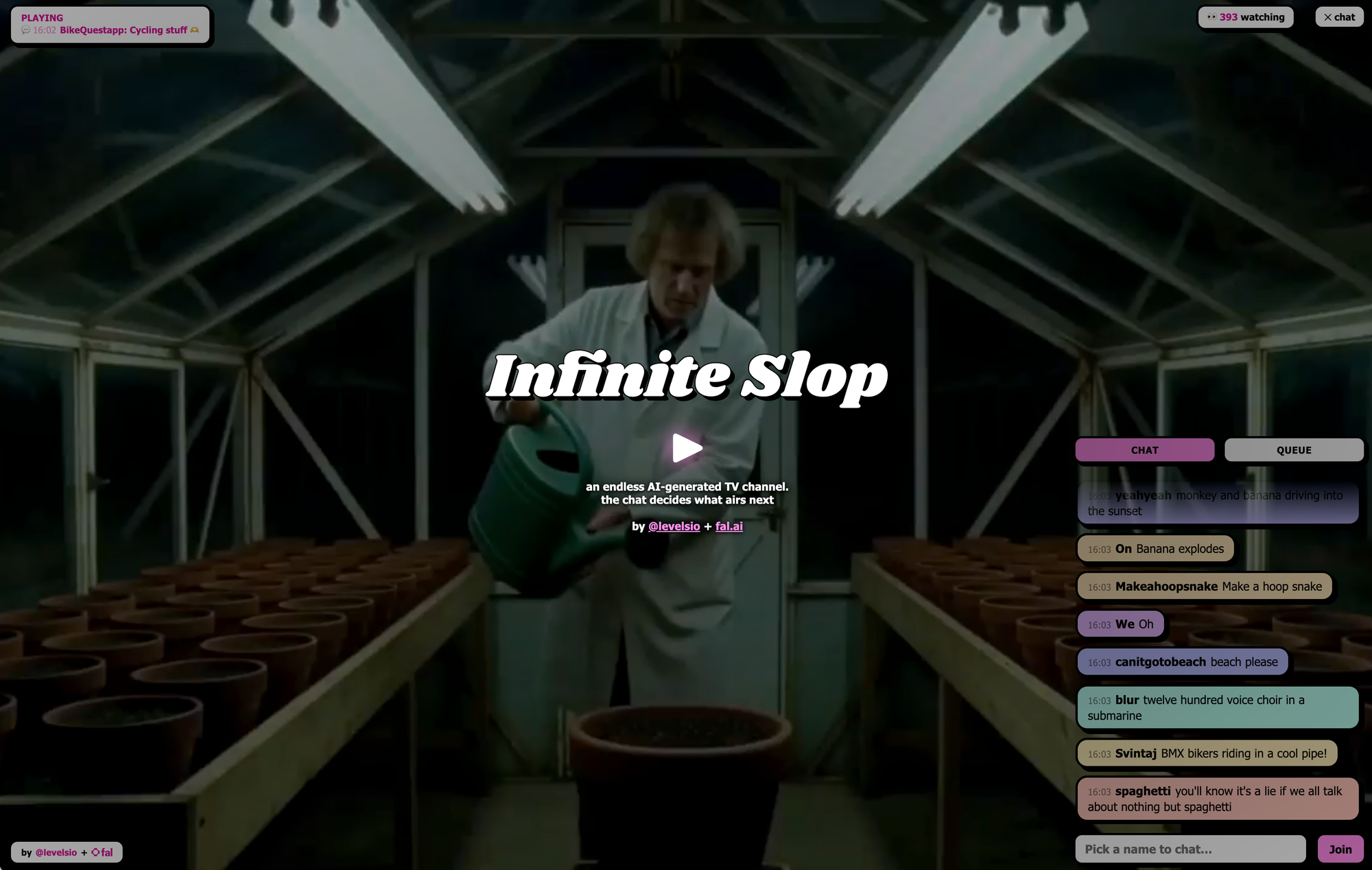
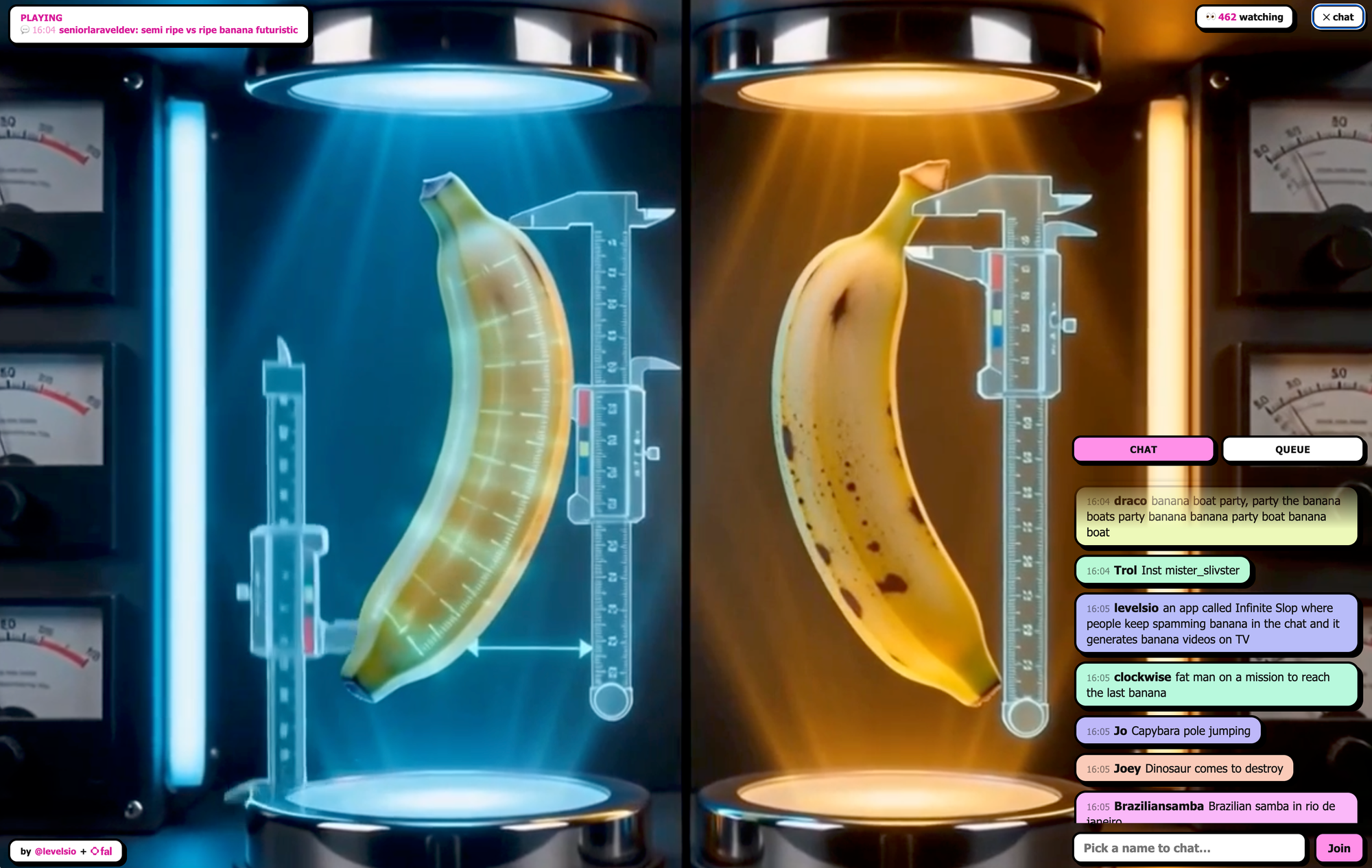
Indie developer Pieter Levels built "Infinite Slop," an AI-generated livestream that runs continuously, with no fixed runtime and no pre-rendered footage. Viewers type into chat, and the system generates the next clip in real time, attempting to connect it narratively to whatever came before. It's a direct, practical demonstration of a claim that's easy to state in a spec sheet and much more interesting to actually watch play out: AI video generation that now runs faster than real-time playback.
The Speed Unlock That Makes This Possible
Okay I built it!
— @levelsio (@levelsio) August 29, 2026
🍰 Infinite Slophttps://t.co/2SykqwedhF
An infinite and interactive AI generated live stream of slop that goes on forever and ever
Anything that you write in the chat is generated next and AI will try to connect it to the previous video so there's an actual… https://t.co/zjm0YEvOQX pic.twitter.com/We7YYMXcGC
The project runs on fal's H3 Max, a post-trained version of MiniMax's open-weight H3 model optimized specifically for generation speed. Where earlier AI video tools typically took two to five minutes to generate 15 seconds of footage, H3 Max reportedly generates that same 15 seconds in about 9 seconds, faster than the clip itself takes to watch. That gap is what makes a genuinely infinite, chat-responsive livestream technically possible in the first place: the system can generate new footage continuously without ever falling behind the stream itself.
Where the Idea Actually Came From
Minimax H3 Max has generates video faster than you can watch it so I hooked it to a twitch livestream! Now you can watch infinite interdimensional cable - link to the stream below pic.twitter.com/LHqHQ9dKMr
— Rehan Sheikh (@rehan_shei) August 29, 2026
Levels credits the original concept to Marc-Antoine Fontaine and Rehan Sheikh, who built an earlier version hooking H3 Max directly to a Twitch stream. Levels then built his own standalone take, hosted independently rather than through Twitch, adding the chat-to-narrative connection as a distinguishing feature. Given how quickly these experimental builds tend to get retired or reworked, don't be surprised if the specific project referenced here has changed or moved on by the time you're reading this, the underlying capability it demonstrates is the more durable part of the story.
What It Actually Costs to Run

Levels noted the project would be prohibitively expensive to operate without fal directly sponsoring the compute, and separately stated the running cost at roughly $4,000 per day. That figure is a useful, concrete data point for anyone trying to understand the real economics of continuous AI generation at this speed, this isn't a toy running on spare capacity, it's a genuinely expensive proof of concept that only exists because a company with a direct interest in showcasing the technology is footing the bill.
Competitive Context
Novelty AI livestream projects aren't new, "AI generates content forever" demos have circulated in various forms since language models first got good enough to hold a conversation. What's different here is the underlying speed claim actually holding up under a real, continuous, public-facing use case rather than staying confined to a benchmark or a short demo clip. That's a meaningfully higher bar to clear than a controlled test environment.
The Signal in the Noise
Speed claims in AI video are easy to make and hard to verify from a spec sheet alone. A project like this, expensive, genuinely continuous, and built by someone with no particular reason to inflate the claim, is a more convincing demonstration than the original announcement was on its own. Whether "infinite AI content" is something audiences actually want to watch for extended periods is a separate question entirely, but as a proof that the underlying generation speed is real, this is about as direct a test as it gets.
Does watching AI generate content in real time change how you think about the speed claims coming out of this space, versus reading a benchmark number?
The Details
- Project: an infinite, chat-responsive AI-generated livestream built by indie developer Pieter Levels
- Underlying model: fal's H3 Max, a post-trained, speed-optimized version of MiniMax's open-weight H3
- Speed claim demonstrated: roughly 15 seconds of video generated in about 9 seconds, faster than real-time playback
- Reported operating cost: approximately $4,000/day, sponsored by fal
- Original concept credit: Marc-Antoine Fontaine and Rehan Sheikh's earlier Twitch-based version