How Director Aidan Cullen Shot a Cosmos Commercial on Film — and Built a $100M Crew Platform on the Side
Director Aidan Cullen breaks down the Cosmos commercial shot on film with Odessa A'zion — and the $100M freelance crew platform he built alongside his directing career.

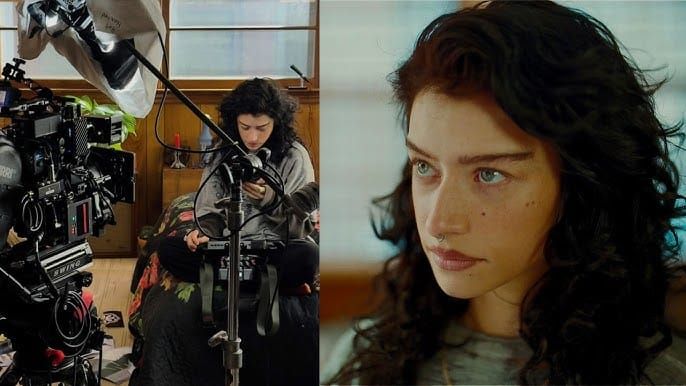
Aidan Cullen directed a commercial for creative platform Cosmos starring Odessa A'zion, shot on film in Staten Island, with VFX work that included recording a vine dying over 60 days. He also co-founded Nova, a platform that has connected freelance creatives with $100 million in jobs over the past two years.
The Frame Set podcast conversation that covers both is worth understanding as a case study in what a contemporary commercial directing career actually looks like — and where the business model is heading.
The Cosmos Commercial
The production for Cosmos leaned into analog process in a way that's becoming more common at the commercial level: shot on film, with VFX and animation handled by Nick Arthur. The practical effects work included recording a vine dying over 60 days — a real-time natural process captured and integrated into the final piece rather than simulated digitally.
The production team included cinematographer Daniel Vignal and production designer Michael Junker, and the campaign stars Odessa A'zion, an actress whose profile has been building steadily. As Cullen describes her trajectory: "You work 10 years to blow up overnight and this is her like moment of that."
The technical philosophy behind the spot reflects Cullen's broader approach to directing: reverse engineer from the edit rather than figure out the edit from what was shot. "You only shoot to edit. So yeah, like reverse engineer it and be like what's the edit going to look like." That's a principle with implications for how the production was planned — every shot justified by a specific editorial function rather than captured speculatively.
The Director's Creative Approach
Cullen's self-description as a director is worth noting because it contrasts with the technical precision the production required: "I'm a pretty laxidasical chill director in the grand scheme of things... I think I'm a lot more of a feeling person."
That combination — technically demanding production choices (film, practical effects, VFX integration) executed by a director who prioritizes emotional response over technical control — describes a specific kind of commercial directing that's become increasingly valuable as brands look for work that feels less produced and more authentic. The film format and the 60-day vine footage aren't just aesthetic choices. They're signals to the viewer that something real was involved in making this.
His background as a creative director spans work with Omar Apollo, Trippie Redd, and current work with Malcolm Todd — a roster that spans music video, commercial, and editorial work in a way that's typical of the director-as-creative-director career path that's emerged alongside the creator economy.
Nova: The Business Behind the Creative Work
The more structurally interesting part of Cullen's career is what he built alongside his directing work. Nova, co-founded with Alex, is a platform connecting freelance creatives with production jobs. Over two years, it has facilitated $100 million in work — a number that suggests it's operating at meaningful scale rather than as a side project.
The positioning is specific: Nova is aimed at professional collaboration and crew-building rather than content discovery. It's not a social feed or a portfolio platform. It's closer to a staffing infrastructure for the freelance production world — connecting the right people to the right projects in an industry where crew relationships are traditionally built through personal networks that take years to develop.
That framing makes Nova a direct response to a real bottleneck in freelance production: the difficulty of building a trusted crew from scratch, especially for younger directors who haven't had the time to develop the network that more established directors rely on.
The Career Advice
Cullen's perspective on building a creative career has a specific quality — direct, unsentimental, and focused on fundamentals rather than strategy.
On professional relationships: "I don't think you fully ever completely like blow up with your friends as an artist. I think you like all get to a certain point and then you need to like go off and do your own things." The implication is that early collaborative relationships are formative but not permanent — the people you build with early in your career are catalysts, not lifelong business partners.
On entitlement: "No one deserves anything." That's a blunter version of the same principle that shows up in most working filmmaker career advice — the industry doesn't reward potential or talent passively. It rewards consistent reliability, hard work, and the willingness to keep learning.
The practical advice he offers for building a crew: do it early, do it in person, and prioritize people who are reliable over people who are talented. Reliable and talented is the goal, but reliability is the harder quality to screen for and the more important one in production.
Competitive Context
Nova sits in a growing category of platforms trying to formalize the informal crew economy. Mandy, ProductionHUB, and StaffMeUp have operated in adjacent spaces for years. What differentiates Nova's positioning — at least as Cullen describes it — is the community and trust layer: a network built around verified professional relationships rather than open marketplace listings.
The broader context is that the freelance production economy has grown significantly as brands have expanded their content production budgets while traditional agency structures have contracted. The demand for professional freelance crews capable of executing high-quality commercial work has outpaced the traditional network-based hiring infrastructure. Platforms that can solve that matching problem have a real market.
The Signal in the Noise
The director-as-founder career path that Cullen represents is worth paying attention to as a structural trend. Experienced commercial directors who understand the production industry's operational problems are increasingly building tools to solve those problems, rather than relying entirely on directing income. Nova is one example. The pattern is showing up across the industry in different forms.
For working filmmakers, the Nova model suggests a specific path for directors who want to build leverage beyond their own shooting schedule: identify a production industry problem you understand deeply from working inside it, and build infrastructure to solve it. Cullen's directing experience is what gives Nova its credibility. Nova's scale is what gives Cullen financial resilience as a director.
The Cosmos commercial itself is almost secondary to that structural story — though it's a good piece of work that demonstrates exactly what a director with that philosophy and that team can produce.
Resources & Reads
- Frame Set's full podcast episode with Aidan Cullen: https://www.youtube.com/watch?v=cq5lTdq3aSo
- Nova platform: search Nova creative platform for current site
- Cosmos creative platform: cosmos.so