Happy Oyster Joins Runway and MiniMax in the Race to Build Interactive Worlds
Alibaba's Happy Oyster joins Runway and MiniMax in the interactive world model race, taking a genuinely different technical path than either.


Alibaba's Happy Oyster, a real-time interactive world model built by the same team behind HappyHorse-1.0, is live now via fal, generating explorable worlds with joint audio and video in a single continuous stream rather than returning a finished clip. It's the third major entry BRC has covered in the interactive world model race this month, joining Runway's GWM Worlds 2 and MiniMax's H3-World, and it's carving out a genuinely different technical approach than either.
What Happy Oyster Actually Does

The model works in two modes. Directing lets a user steer a running scene in real time, up to three minutes at 480p or 720p, using text, voice, or image input, closer to giving live notes on a shot than submitting a prompt and waiting. Wandering lets a user move freely through an endlessly extendable world instead, exploring rather than directing a specific narrative.
Both modes generate video and audio jointly in one continuous stream, with physics that stay coherent as the world evolves, objects hold their position, light behaves consistently, motion carries through rather than resetting between generated segments. It accepts text, voice, image, and keyboard input, and responds to that input live as the world is being generated, not after the fact.
A Genuine "Third Path" Among World Models

Chinese tech outlet 36Kr frames Happy Oyster's positioning clearly against its two most obvious points of comparison. Google's Genie focuses on real-time interactive world modeling but has real limitations unifying multimodal input with joint audio-video generation.
World Labs, led by Fei-Fei Li (the company behind Atlas, which BRC covered last week), takes a different route entirely, emphasizing 3D spatial reconstruction and geometric consistency over long-term dynamic generation in pixel space.
Happy Oyster instead commits to long-term, real-time interactive simulation directly in pixel space, with joint audio-video generation layered on top, a combination the outlet describes as a path few competitors have successfully executed.
Where This Connects to a Bigger Announcement

At a Venice Film Festival panel this weekend, Tianshu Zhu, head of global AI product solutions at Alibaba Token Hub, said the company plans to launch HappyHorse 2.0 alongside a companion tool called HappyHorse Control, also described as a "world model" for real-time interaction, by the end of September.
Whether that's a direct successor to Happy Oyster, a rebrand, or a related but distinct product isn't fully clear from public reporting yet, but it signals Alibaba is treating interactive world modeling as a continuing priority, not a one-off release.
Zhu also framed the broader HappyHorse effort around solving budget and resource constraints specifically, with a focus on pre-production tasks like storyboarding and previsualization, rather than positioning it as a replacement for good storytelling.
Competitive Context
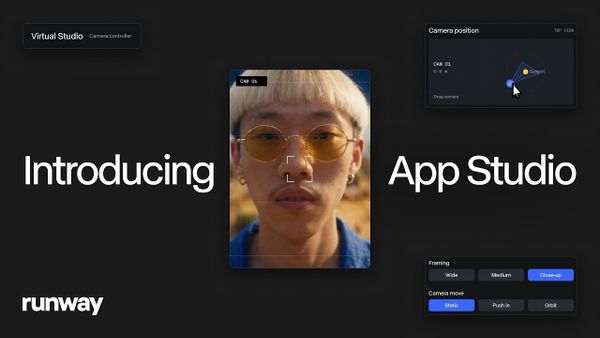
This gives BRC readers three genuinely distinct technical approaches to compare within a single month. Runway's GWM Worlds 2 splits use into three authoring modes, ahead-of-time scripting explicitly aimed at filmmaking and directing, turn-based for visual novels, and real-time for games, built around its WorldPrompt framework separating persistent world state from a timestamped action stream.
MiniMax's H3-World takes the opposite approach entirely, adapting an existing 33-billion-parameter video model into a keyboard-controlled simulator using a tiny, efficient LoRA rather than a purpose-built architecture. Happy Oyster sits between those in spirit, purpose-built like Runway's model, but leaning harder into open-ended exploration and joint audio-video generation as its core differentiator.
The Signal in the Noise
Three well-resourced companies converging on interactive world modeling within weeks of each other, using genuinely different technical approaches, is a strong signal this is becoming a real competitive category rather than a research curiosity any one lab is chasing alone.
HappyHorse-1.0 already topped LM Arena's video editing leaderboard ahead of international competitors, so Alibaba isn't a fringe player experimenting here, it's a serious contender with real benchmark results behind it.
Given three different technical philosophies now competing in this space, which approach, Runway's scripted authoring, MiniMax's efficient adaptation, or Alibaba's open-ended exploration, seems most useful for actual filmmaking work to you?
The Details
- Model: Happy Oyster, Alibaba Token Hub (ATH), built by the team behind HappyHorse-1.0
- Modes: Directing (live-steered scene, up to 3 min at 480p/720p) and Wandering (free exploration of an extendable world)
- Output: joint audio-video generation in one continuous stream, coherent physics over time
- Input types: text, voice, image, keyboard
- Access: available now via fal, official API partner
- Related upcoming release: HappyHorse 2.0 plus a companion tool called HappyHorse Control, described as a real-time interactive "world model," expected by end of September 2026 (per Alibaba Token Hub's Tianshu Zhu at a Venice Film Festival panel)
- Context: HappyHorse-1.0 scored 1,299 Elo on LM Arena's Video Edit leaderboard, ranking first globally
Resources & Reads
- Happy Oyster on fal
- 36Kr: Alibaba's World Model "Happy Oyster" Carves Out Third Path
- Variety: AI Filmmaking Debated by Alibaba, Sonilo, PROMPTR at Venice Panel
- BRC: Runway's Next World Model Can Be Directed Like a Film, or Played Like a Game
- BRC: MiniMax H3 Can Now Be Steered Like a Game, Using Barely Any New Training