Why Black Forest Labs Is Taking Its Video Model Into Robotics
Black Forest Labs built a robot-control model on the same video training as FLUX 3. Here's what that says about where AI video labs are headed.

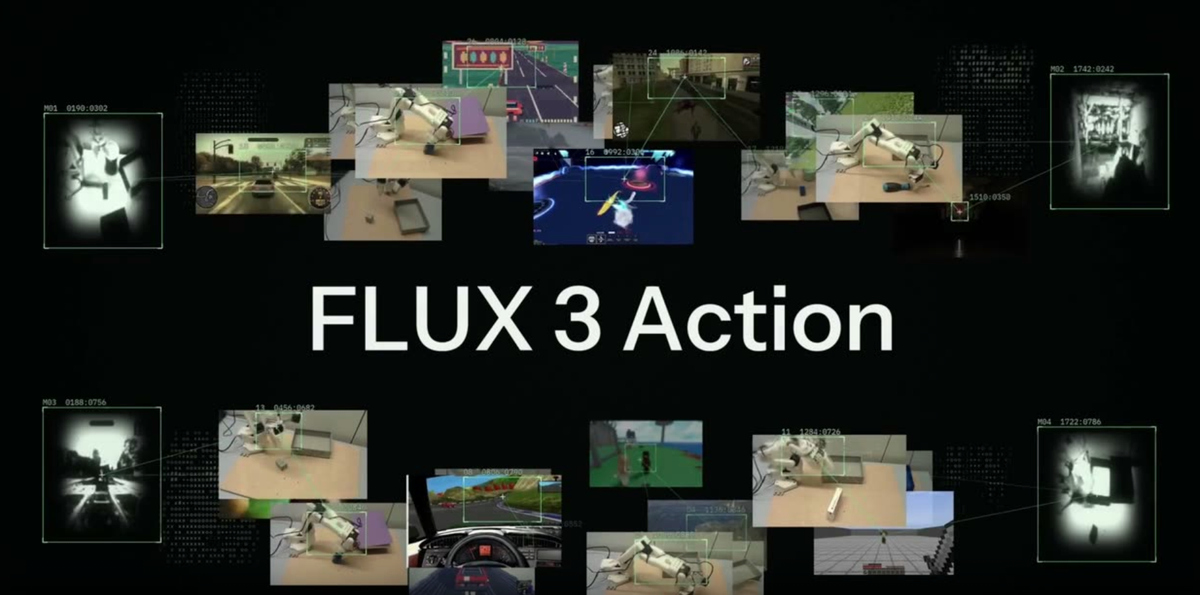
Black Forest Labs, the company behind the FLUX image and video models, released FLUX 3 Action, an open-weights model that controls robots. It isn't a filmmaking tool. But it's built on the same video training as FLUX 3, and that makes it a useful signal about where the labs behind AI video tools are placing their bets.
What FLUX 3 Action Actually Is
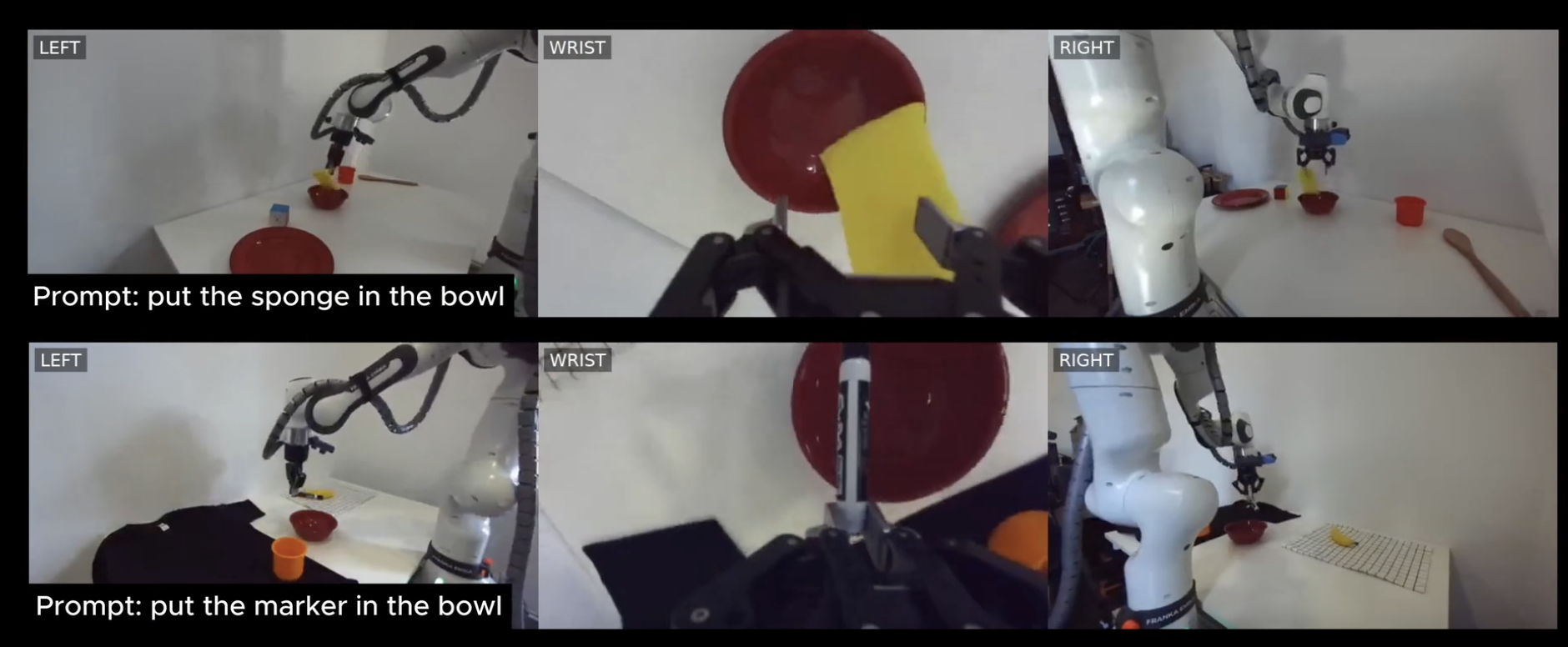
FLUX 3 Action is a 7-billion-parameter "world action model." Given a task like "put the red cube in the left bin," plus camera images and a robot's joint positions, it predicts both the robot's next movements and what the scene should look like as those movements happen.
That joint prediction is the key idea. The model isn't just choosing actions. It's imagining the next few seconds of video alongside them, and using that imagined future to decide what to do.
The Video Connection
FLUX 3 Action is derived directly from FLUX 3, BFL's multimodal model. According to BFL, video made up more than 95% of FLUX 3's pretraining tokens, alongside images and audio.
BFL then added an action-focused training phase mixing its original video data with footage that includes recorded actions. Game recordings made up about 20% of those training samples, alongside first-person videos of human hands, handheld gripper footage, and robot teleoperation data.
BFL's own testing shows why the video pretraining matters. Without it, the model succeeded on less than 1% of benchmark tasks. With it, performance jumped immediately and kept climbing through later training.
In other words, the skill of predicting what comes next in a video turned out to be a strong foundation for deciding what a robot should do next.
How It Performs
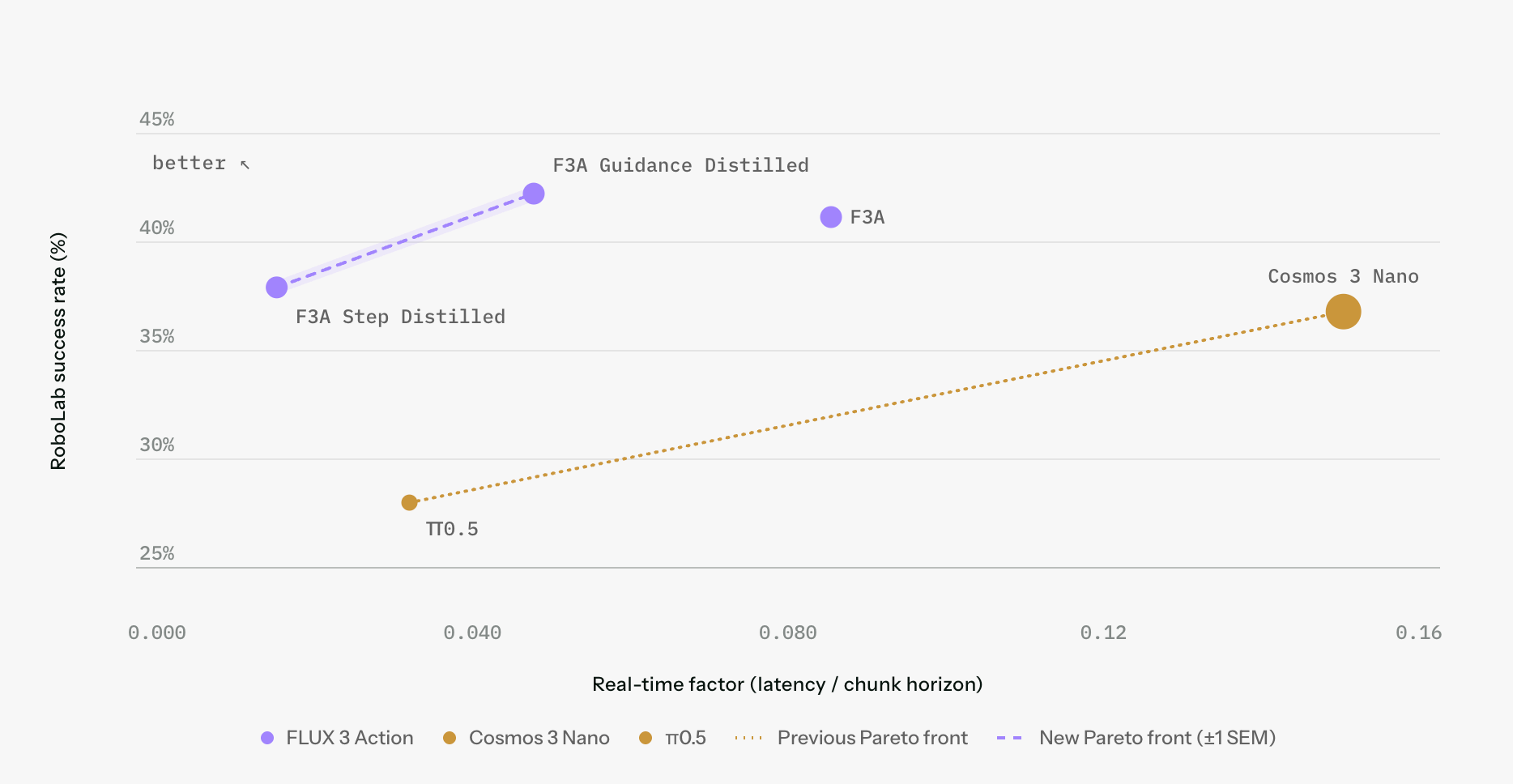
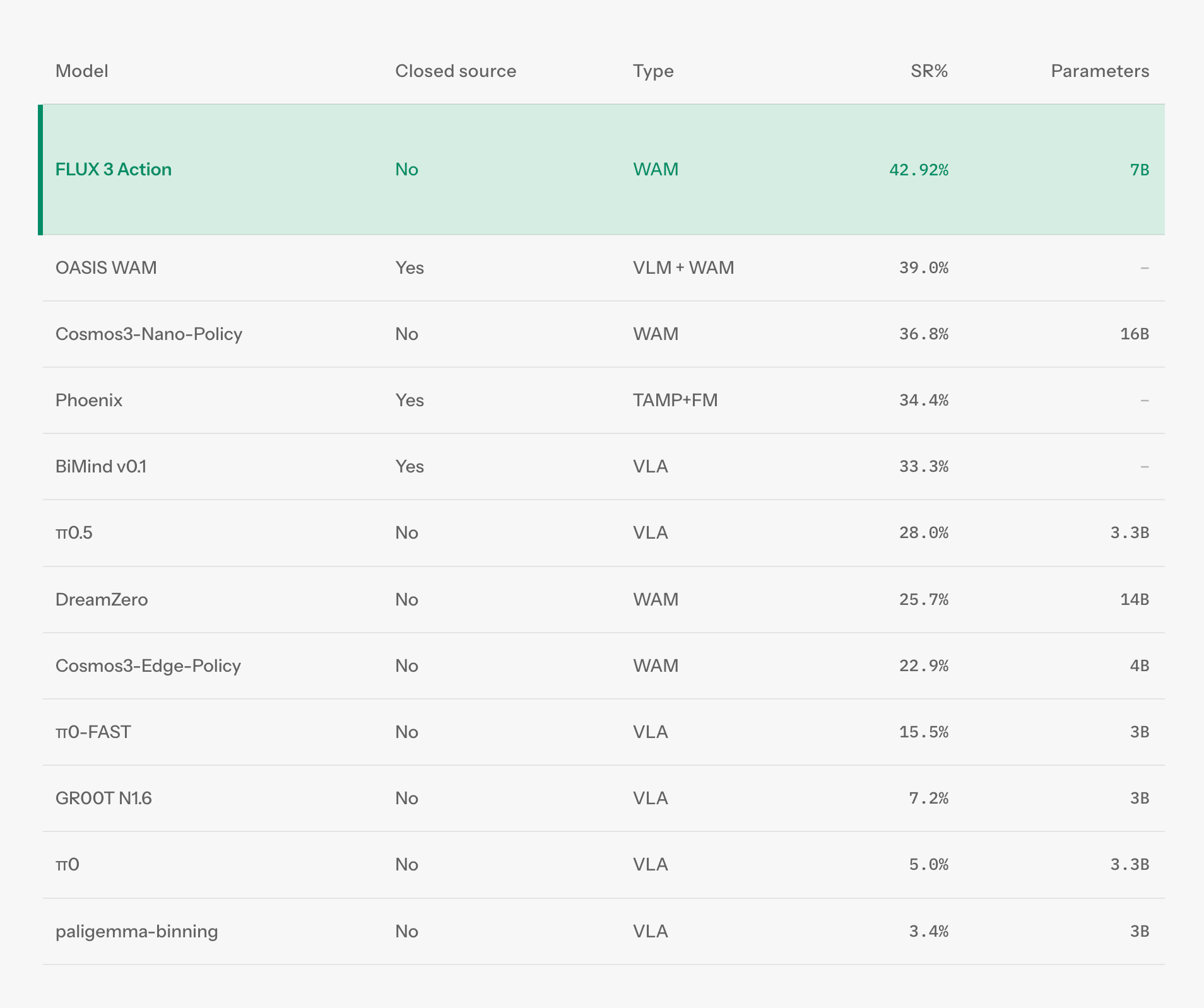
On NVIDIA's RoboLab-120 benchmark, BFL reports FLUX 3 Action as the top open model, with success rates of roughly 38% to 42% depending on the version. The previous best open model, NVIDIA's Cosmos 3 Nano, scored 36.8% while using more than twice the parameters.
The distilled versions also run far faster. BFL says its guidance-distilled model runs roughly 3x faster than Cosmos 3 Nano, and it plans more than twice as far ahead per prediction as Pi0.5, a leading open robotics model.
These are mostly BFL's own results, but there's one independent check. Positronic Robotics ran the model on a real robot arm across ten tasks, with the operator not told which model was running. FLUX 3 Action completed 28 of 30 attempts, edging out Cosmos 3 Nano at 27 of 30.
Pairing Fast Action With a Reasoning Model
One of the more interesting findings involves OpenAI's GPT-6 Astra. Astra can solve every task in one robotics benchmark on its own, but it's slow and expensive, averaging about 16 minutes and $13.47 per success.
BFL tested letting Astra supervise FLUX 3 Action, stepping in only when the faster model needed help. That hybrid succeeded on 90% of tasks while cutting the cost to $8.77 and the time to about 8 minutes per success. It's an early example of a large reasoning model directing a small, fast model rather than doing everything itself.
Beyond Robots
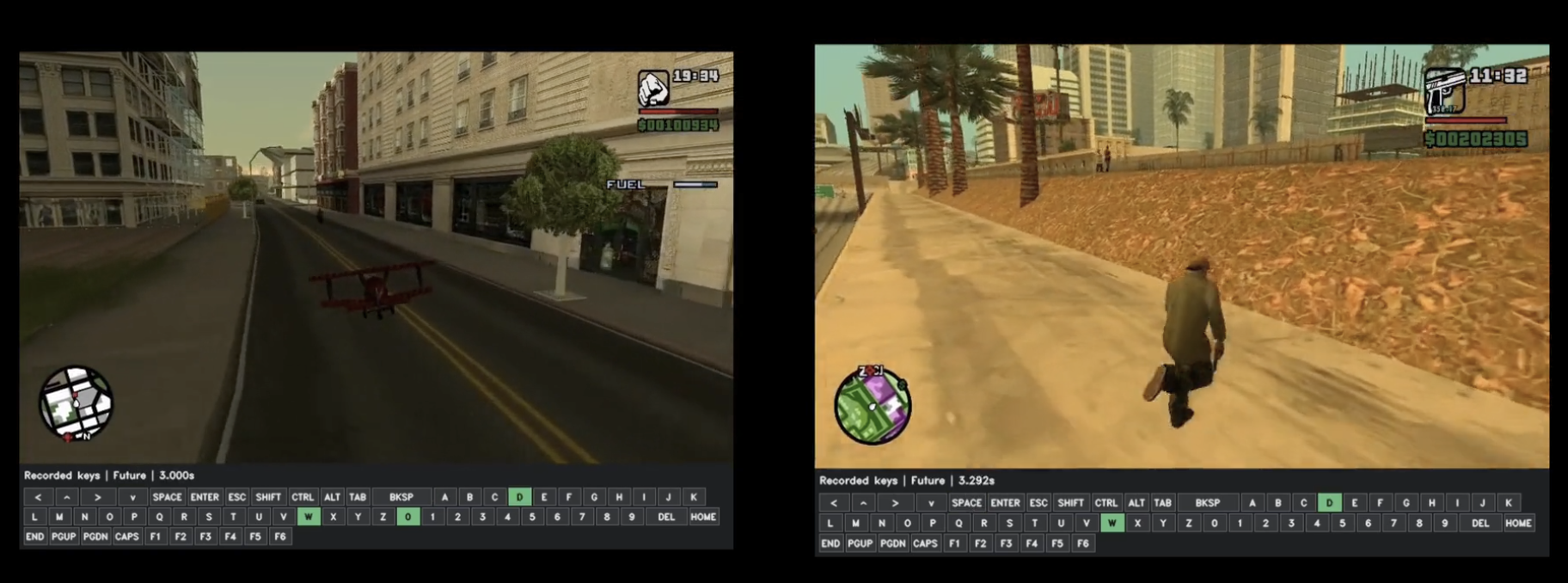
BFL says it's seeing promising early results in simulated environments like gaming, vehicle control, and computer use. The company calls games an ideal testbed, since they can run in parallel, faster than real time, and without physical risk.
BFL's own framing is notable here. It suggests an agent that can play games is "just one short step from operating other software."
Open Weights and Availability
BFL released the weights, code, fine-tuning recipe, and benchmarks. It also worked with NVIDIA to integrate the model natively into Hugging Face's LeRobot library, with deployment support for NVIDIA Jetson edge hardware.
Teams can fine-tune FLUX 3 Action on their own demonstrations to build a policy for a specific robot and task. BFL tested exactly that with a small dataset on the low-cost SO-101 robot arm.
Competitive Context
BFL isn't the only video lab heading this direction. Runway has pushed its world models toward robotics and simulation, and NVIDIA's Cosmos models are built explicitly for physical AI. The shared logic is that a model trained to predict how the visual world changes over time is also learning something about how to act in it.
For AI video users, that's worth knowing. The research budgets behind the tools filmmakers use are increasingly split between making better video and using video models as a foundation for robots, games, and software agents.
The Signal in the Noise
The practical question for creators isn't whether they'll use FLUX 3 Action. They almost certainly won't. It's what this means for the video models they do use.
There are two readings. The optimistic one is that video models are becoming foundational technology with value far beyond media, which should keep investment in them high. The cautious one is that as robotics and simulation become more commercially valuable, a lab's best research effort may drift away from creative tools.
Either way, "AI video company" is starting to look like an incomplete description of what these labs actually are.
Does it change how you think about the AI video tools you rely on, knowing the same underlying models are being trained to control robots and play games?
The Details
- Model: FLUX 3 Action, by Black Forest Labs
- Size: 7B parameters, open weights
- Foundation: derived from FLUX 3, whose pretraining was more than 95% video
- Function: predicts robot actions and future video frames together
- Benchmark: top open model on NVIDIA's RoboLab-120, per BFL (~38–42% success)
- Real-robot test: 28 of 30 tasks completed in an independent evaluation by Positronic Robotics
- Speed: plans 2.13 seconds of motion per prediction, versus 1.0 second for Pi0.5
- Released: weights, code, fine-tuning recipe, benchmarks, and examples
- Integrations: Hugging Face LeRobot; NVIDIA Jetson edge deployment
- Other uses explored: gaming, vehicle control, computer use