How One Solo Filmmaker Built a Professional Monitor Rig From Scrap Wood and a License Plate
Solo filmmaker Evan Monsma built a wireless director's monitor rig from scrap wood, a license plate, and 3D-printed parts around a 7-inch Blackmagic monitor. Here's the full build breakdown.

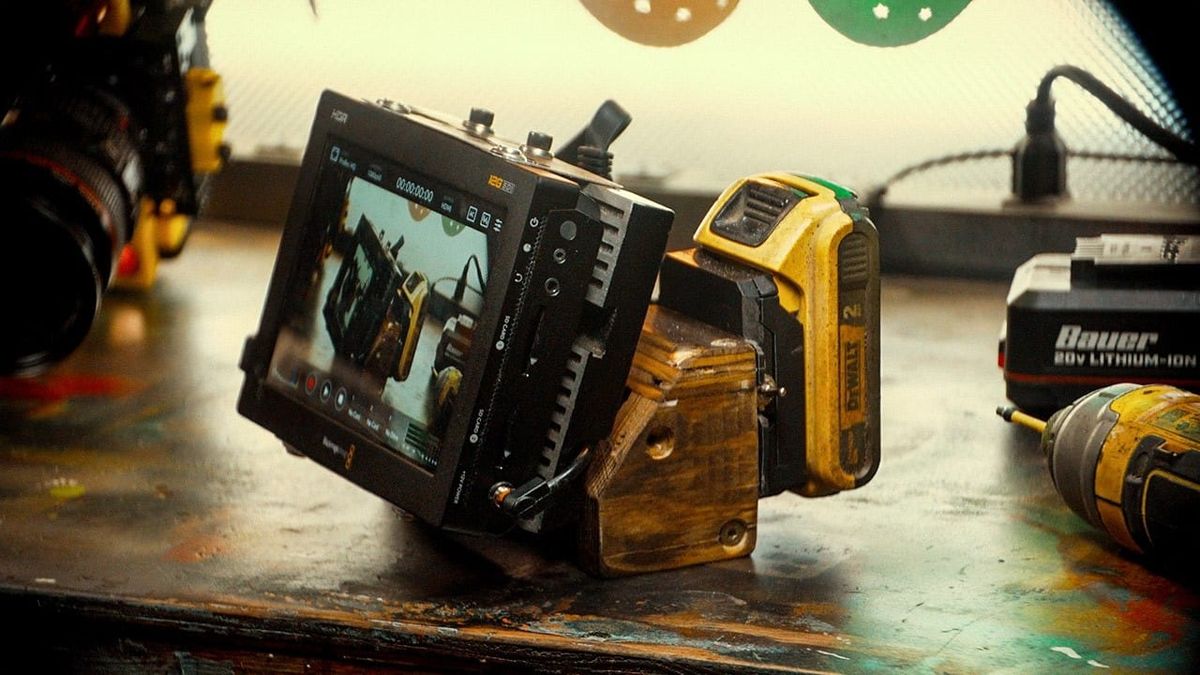
Evan Monsma's old DIY monitor rig finally gave out. So he built a better one from plywood, a discarded belt sander plate, an old license plate, and a handful of 3D-printed parts.
The Build
The centerpiece is a 7-inch Blackmagic monitor, which Monsma received from Blackmagic directly. Everything else in the rig came from his shop, his scrap bin, or a Harbor Freight run.
Power comes from a DeWalt battery system with a voltage regulator stepping down the output to match the monitor's requirements. Wireless signal runs through an HDMI transmitter, with a pass-through that lets the monitor feed simultaneously to both a local display and a streaming destination. A 45-degree adjustable hinge handles ergonomic positioning for solo monitoring while operating the camera.
The structural components are a mix of plywood, a repurposed belt sander table plate for the base, license plate metal for brackets, and PLA 3D-printed parts for the mounting hardware. Monsma distributes the 3D print files for free on his website, so the functional components of the rig are fully replicable by anyone with a printer.
As Monsma puts it in the video: "It's always fun when there's an opportunity to mix all kinds of skills and materials together... dive into a project with no plan sometimes, make something, make tweaks, keep changing it until eventually there's something pretty cool sitting on your desk."
Why Build Instead of Buy
The commercial alternative to a rig like this is a proprietary all-in-one production monitor setup — SmallHD, Atomos, or similar — which can run anywhere from $500 to well over $1,500 once you factor in a mounting solution, power system, and wireless receiver. Monsma's build integrates all of those functions for the cost of the Blackmagic monitor itself plus whatever scrap wasn't already on hand.
The more important advantage for a solo workflow isn't the cost savings. It's modularity. A commercial rig is designed around its manufacturer's ecosystem. A DIY rig built from discrete components — a separate monitor, a separate wireless transmitter, a separate battery system — can be repaired, upgraded, or reconfigured one piece at a time. When something fails, you replace that component, not the whole unit.
Competitive Context
The DIY monitor rig sits in a long tradition of solo filmmakers building their own production infrastructure rather than buying into proprietary systems. Blackmagic's own monitor line has become a popular starting point for these builds precisely because the monitors are priced accessibly for their spec level — the 7-inch Blackmagic Video Assist line starts around $595, significantly below comparable SmallHD or Atomos units at similar sizes.
The 3D printing component is worth noting separately. Affordable desktop FDM printers have made custom bracket fabrication accessible to anyone willing to learn basic CAD or download existing files. The ability to print a custom mount for a specific combination of components — rather than hunting for an off-the-shelf bracket that almost fits — is a meaningful capability shift for DIY production gear.
The Signal in the Noise
This isn't a build that scales to a multi-camera crew setup. It's engineered specifically for the constraints of solo production: one operator, wireless monitoring at a distance from the camera, no dedicated AC or grip department. Within those constraints it's a well-considered solution, and the decision to share the 3D print files for free makes it a genuinely useful reference for other solo operators facing the same problem.
The broader principle is the same one that shows up in most smart indie gear decisions: buy or build around the specific workflow, not around the spec sheet. A $1,500 commercial monitoring solution designed for a multi-person crew has features a solo operator will never use and a form factor built for a cart, not a tripod arm.
Specs & Pricing
Key components in Monsma's build: 7-inch Blackmagic Video Assist monitor (retail approximately $595), DeWalt 20V battery system with voltage regulation, wireless HDMI transmitter (brand unspecified in the research package), plywood and license plate metal for structural components, PLA 3D-printed mounts. Total build cost beyond the monitor itself is minimal given the use of scrap materials. 3D print files are available free on Monsma's website.
Resources & Reads
- Evan Monsma's full build video: https://www.youtube.com/watch?v=MJSlTrFgZAI
- Free 3D print files for the battery mount and bracket components: available via Monsma's website (linked in his video description)
- Blackmagic Video Assist 7-inch monitor: https://www.blackmagicdesign.com/products/blackmagicvideoassist