This Videographer's Drone Flight Led to Federal Charges — Here's the Airspace Check You Can't Skip
A videographer faces a year in prison for a 2-minute drone flight to film his own church. Here's what went wrong, and the airspace check every drone operator needs before flying.
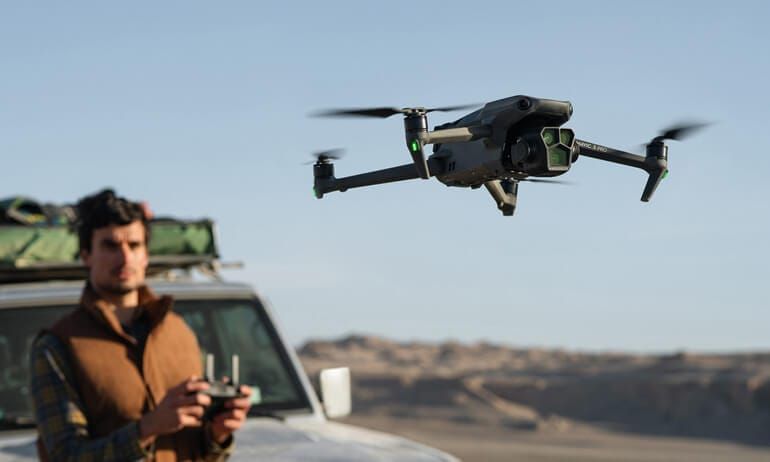
John Alexander Meza flew a DJI Mavic 3 for about two minutes on June 11, 2026, to get footage of Houston's First Baptist Church, where his LinkedIn profile identifies him as the church's cinematographer. He's now facing federal charges that carry up to a year in prison and $100,000 in fines.
No World Cup match was even being played in Houston that day, the city's first game wasn't until June 14. But East Downtown Houston had been designated a temporary "no drone zone" for the entire tournament, and thousands of people were gathered a few blocks away at the World Cup fan festival on Live Oak Street.
What Actually Went Wrong
According to court records obtained by Houston Public Media, Meza confirmed to FBI agents that he'd been piloting the drone and that he was filming the church. He also acknowledged two things that turned a routine flight into a federal case: he didn't hold a remote pilot certificate, and he hadn't checked for active flight restrictions before flying.
The FAA had designated the area within a one-mile radius of the fan festival, up to 1,000 feet, as restricted airspace for the tournament's entire duration, with even tighter restrictions near NRG Stadium on match days specifically. Meza is now charged with violating national defense airspace.
This Isn't an Isolated Case
Meza is one of as many as 16 people facing federal charges for drone violations in Houston alone during the World Cup, according to the FBI's Houston field office, and that number wasn't final as of publication. Nationally, the FBI reports seizing more than 700 illegal drones and detecting nearly 1,600 total around the tournament's 11 U.S. stadiums.
Two other Houston cases show a pattern worth noting: both defendants told authorities they were flying to shoot real estate photography, not sports coverage. This isn't just a sports-event enforcement story, it's evidence that FAA enforcement around any temporary restricted airspace, regardless of the pilot's actual purpose, has become considerably more serious than a lot of working videographers may assume.
The Airspace Check That Actually Matters
This is the part every drone operator, not just anyone shooting near a stadium, should treat as a hard rule, not an occasional habit.
Check the specific location, on the specific day, every single time. Airspace restrictions aren't static. A location that's completely legal to fly on a Tuesday can become a federally restricted no-fly zone with a temporary flight restriction (TFR) issued with limited advance notice, for a sporting event, a VIP visit, an emergency response, or dozens of other reasons. Re-checking on the actual day of a flight, at the actual location, isn't excessive caution, it's the baseline.
Use an FAA-approved airspace app before every flight. B4UFLY is the FAA's public awareness tool, now operated by Aloft, available as a free app or web tool with no account required. Drop a pin at your exact launch location, and it shows controlled versus uncontrolled airspace, maximum authorized altitudes, restricted or prohibited zones, and any active TFRs. Other FAA-approved providers include Airspace Link and DroneUp Go.
Understand that B4UFLY and LAANC answer different questions. B4UFLY tells you whether you can legally fly at a location. LAANC (Low Altitude Authorization and Notification Capability) is the separate system that grants actual authorization to fly in controlled airspace below 400 feet, near airports specifically. If you're in controlled airspace, checking B4UFLY alone isn't enough, you need LAANC authorization too, and most B4UFLY-integrated apps let you request it in the same interface.
Cross-reference the FAA's own TFR site for anything time-sensitive. For events, stadiums, or anything with a known date, checking the FAA's official TFR page (tfr.faa.gov) directly is worth the extra step beyond an app's cached data, since TFRs can be issued or updated with very short notice.
Get certified if you're flying for any commercial purpose. Meza's case involved church production work, arguably commercial or at least organizational use, not purely recreational flying. Anyone flying a drone as part of paid or professional video work needs a Part 107 remote pilot certificate, not just the Recreational UAS Safety Test (TRUST) required of hobbyists.
Why Enforcement Has Actually Changed
This case reflects a real shift, not just World Cup-specific vigilance. Remote ID, now required on most drones, broadcasts a drone's identification, position, and the pilot's location in real time. A sensor detecting a violation doesn't just log an aircraft, it identifies exactly who's holding the controller, which is a meaningfully different enforcement environment than existed even a few years ago. Combined with FAA policy that's reportedly shifted this year toward pursuing legal action rather than issuing warning letters for airspace violations, the margin for "I didn't know" has gotten considerably thinner.
The Signal in the Noise
The actual lesson here has nothing to do with malicious intent, Meza wasn't trying to surveil a stadium, he was filming his own church. That's exactly why this case matters for working videographers broadly: good intentions and a legitimate reason for flying don't change the legal exposure if the airspace itself is restricted and you haven't checked.
A 30-second airspace check before every flight is a genuinely trivial cost against a potential year in prison and six-figure fines, and treating that check as optional, especially near any major event, stadium, or gathering, is the actual mistake worth learning from here.