This Free Tool Turns 300 Cinema Techniques Into Ready-Made Grok Prompts
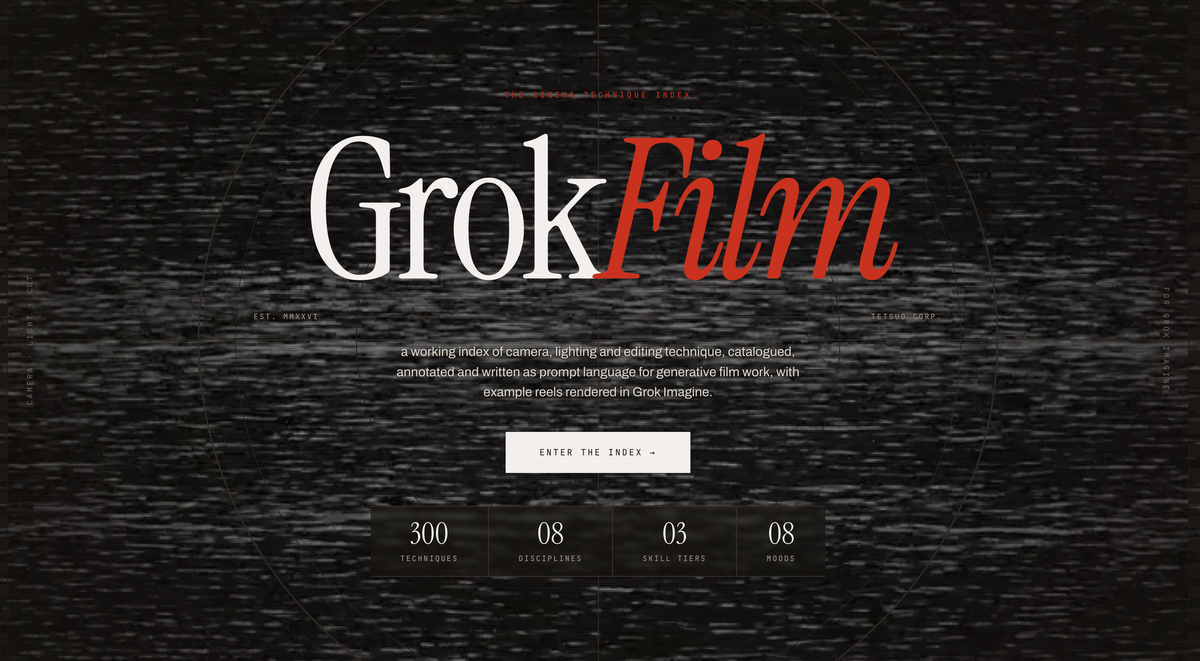
GrokFilm is a free, searchable index of 300 cinema techniques, each written as ready-to-use prompt language for Grok Imagine. Here's how it actually helps.

Anyone who's tried to get a specific cinematic look out of an AI image or video generator knows the real bottleneck usually isn't the model, it's finding the right words. "Make it look more dramatic" doesn't do much. "Chiaroscuro lighting with a Dutch angle" does a lot more, if you know those terms exist and how to phrase them.
GrokFilm is a free reference tool built specifically to close that gap for Grok Imagine, xAI's image and video generation tool.
What It Actually Is
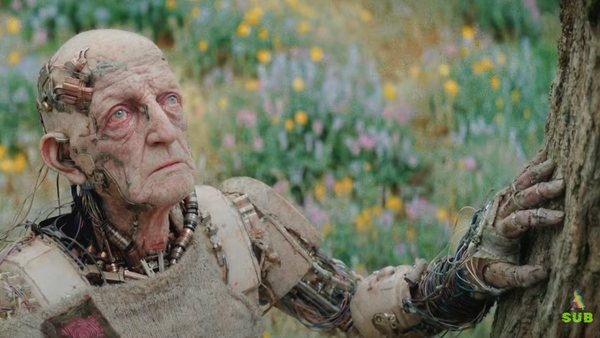
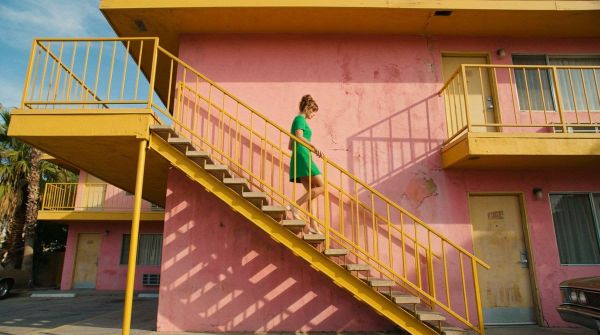
GrokFilm just leveled up: 300 cinema techniques for @grok Imagine, now with example reels rendered in Grok itself.
— acidburn (@signerless) August 2, 2026
Dutch angles, chiaroscuro, film noir, kaiju...
Each one is a ready-made prompt + one-click "Try in Grok".
Think like a cinematographer.https://t.co/jOGfjGlOyd… pic.twitter.com/SLYpsTuzLu
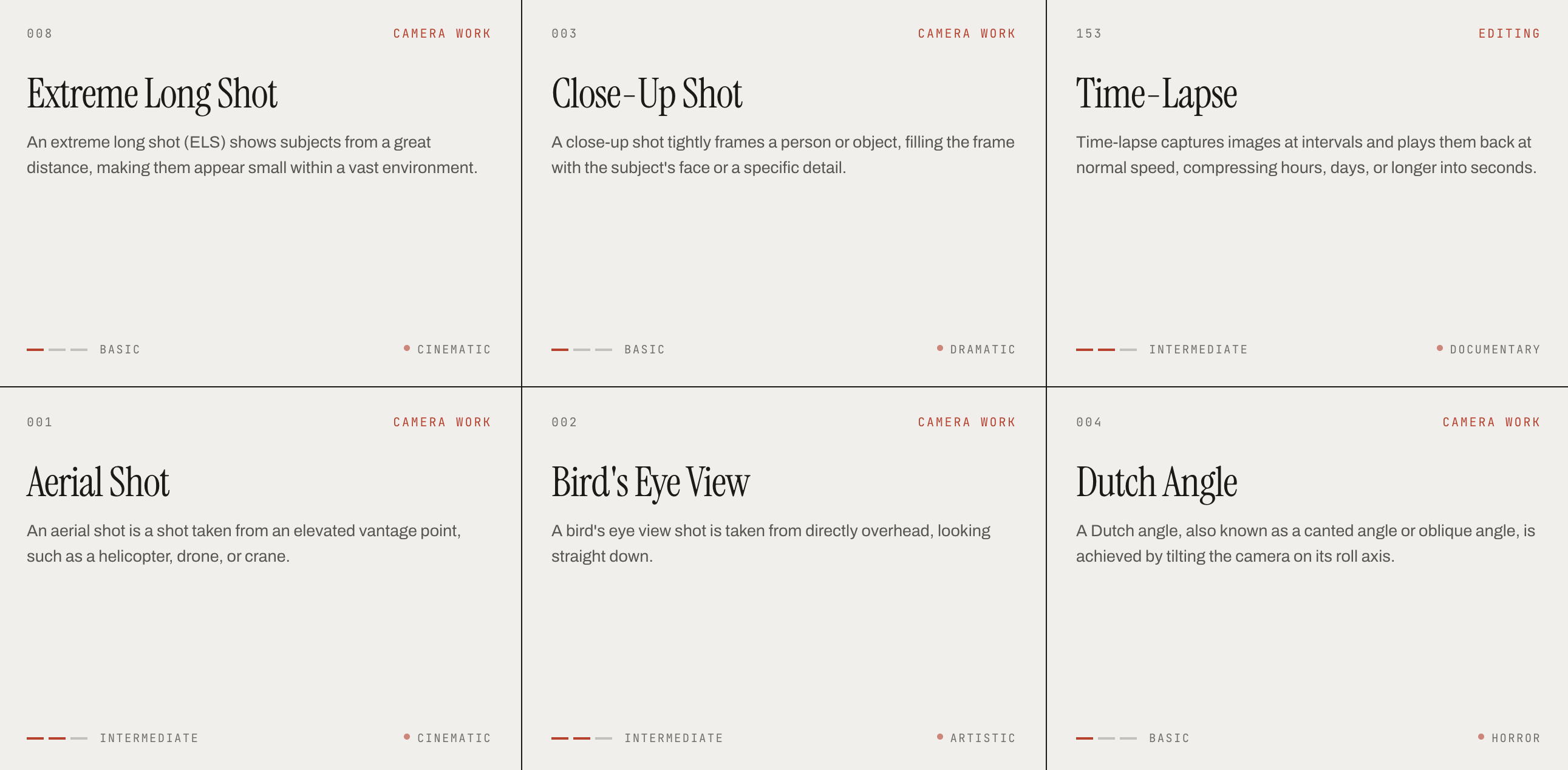
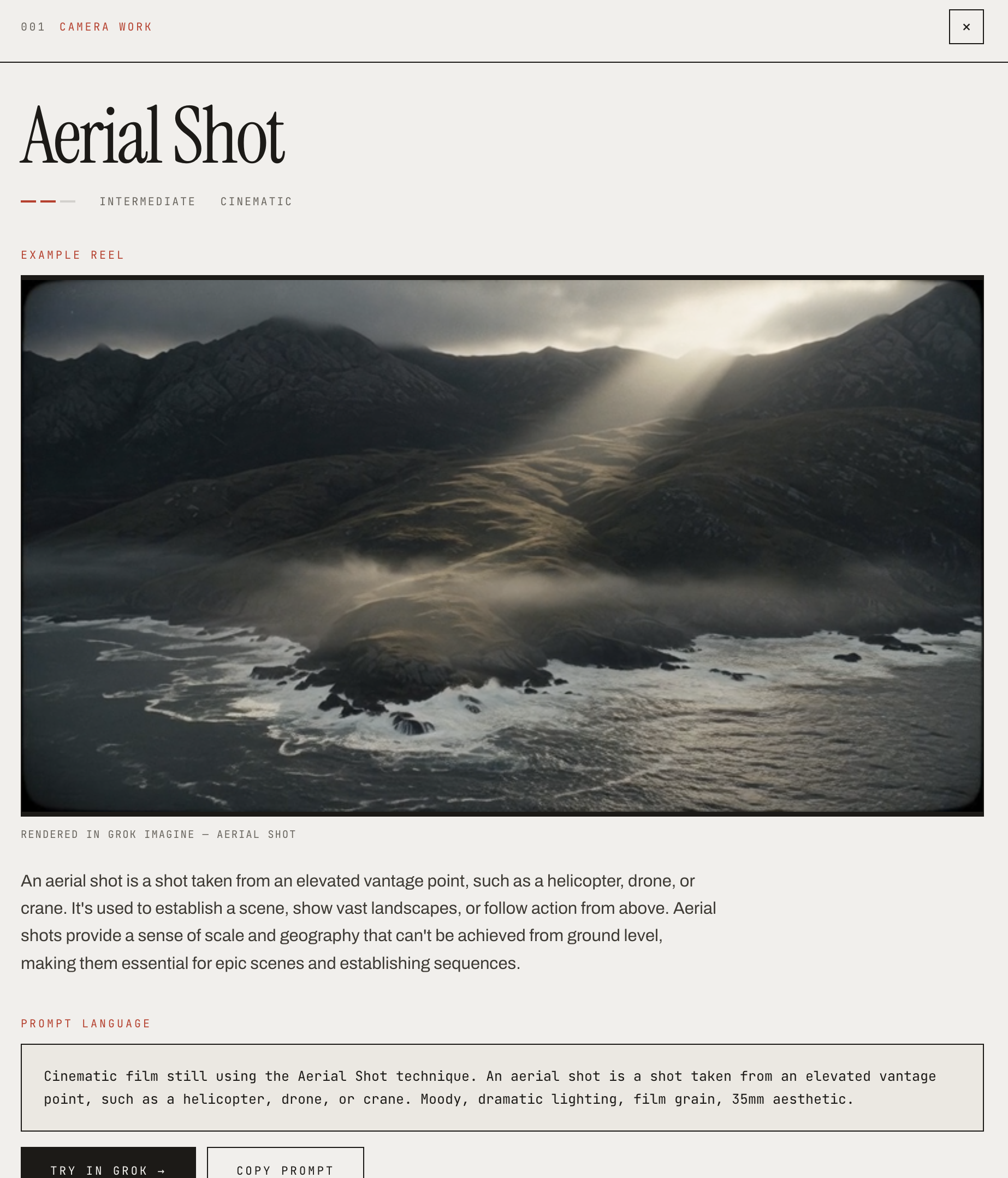
GrokFilm is a searchable index of 300 cinema and photography techniques, camera work, lighting, composition, editing, sound design, storytelling, visual effects, and genre styles, each one written as ready-to-use prompt language rather than a dry textbook definition. Entries range from foundational basics (Extreme Long Shot, Bird's Eye View) to more specific, mood-driven techniques (Dutch Angle, film noir styling, kaiju-scale framing).
Every technique includes a difficulty tier, a mood tag, and a short explanation of what it actually does visually, alongside a ready-made prompt and a one-click "Try in Grok" button that sends the prompt directly into Grok Imagine. There's also a "copy prompt" option for anyone who wants to adapt the language rather than use it as-is.
Why This Is Could Be Useful
The real value here isn't the novelty of having a list of camera terms, it's the translation layer between film vocabulary and prompt engineering specifically. Most people who understand cinematography terminology aren't necessarily fluent in how to phrase that terminology for an AI model to actually interpret correctly, and most people fluent in prompting AI tools don't necessarily know film terminology in the first place. GrokFilm sits directly at that intersection, letting someone browse by mood or technique and get a prompt that's already been tuned for the specific model it's built for, rather than guessing at phrasing through trial and error.
For anyone using Grok Imagine for AI filmmaking work, this is a genuinely practical shortcut: instead of describing what you want in plain language and hoping the model interprets your intent correctly, you can start from an established cinematography term with prompt language already calibrated to get that specific look.
Worth Knowing
GrokFilm is explicitly built and tuned for Grok Imagine specifically, not a general-purpose prompt library, so the exact prompt language may not transfer cleanly to other AI video or image tools without adjustment.
It's also a young, independently built project (labeled "Vol. 01" with more techniques and a "GrokFilm Studio" build tool reportedly still in development), not an official xAI product, so treat it as a useful third-party resource rather than an endorsed or permanent part of Grok's own toolset.
The Signal in the Noise
Prompt libraries like this are a small but genuinely useful category worth watching more of as AI video tools mature: the gap between "knowing what look you want" and "getting the model to actually produce it" is often more about vocabulary and phrasing than raw model capability.
A free, well-organized reference that bridges cinematography language and prompt engineering is a legitimately practical tool for anyone working with Grok Imagine specifically, and a template worth expecting other AI video platforms to get their own version of eventually.