Adam Savage Goes Inside IMAX to Show How 70mm Film Projection Actually Works
Adam Savage tours IMAX LA to show how 70mm film projection actually works — 600-pound reels, rail systems, hybrid projection booths, and why this infrastructure still exists.

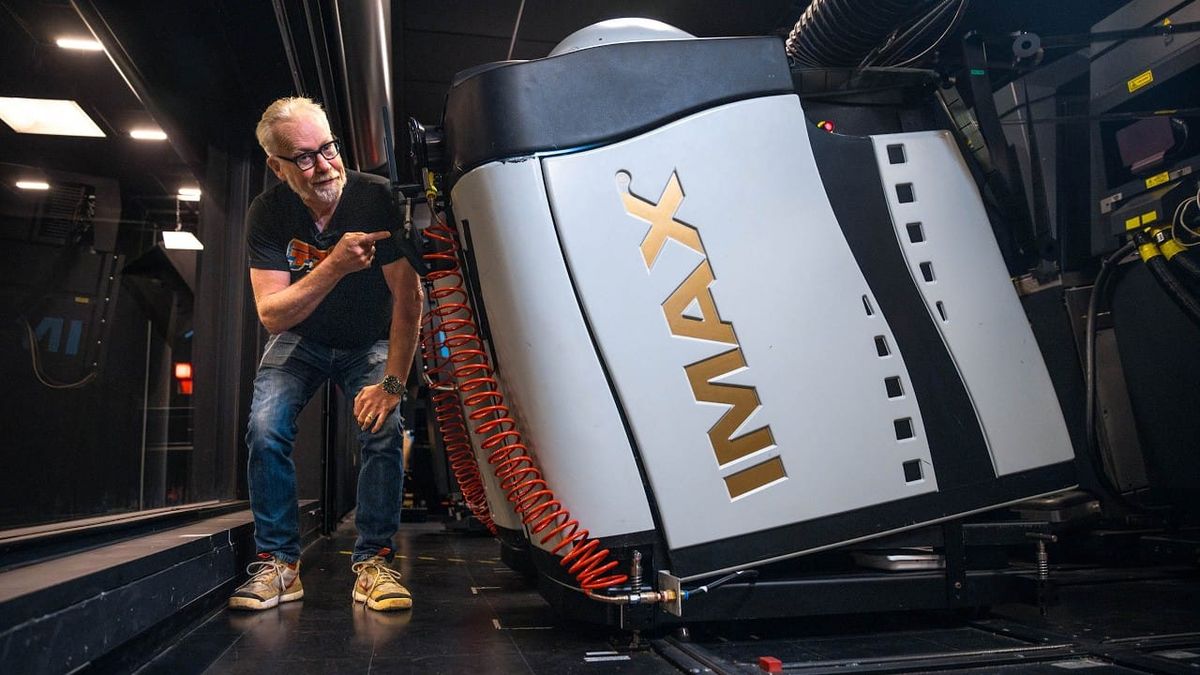
Most filmmakers know IMAX 70mm looks different. Fewer know what it actually takes to run it.
Adam Savage visited IMAX's LA headquarters to walk through the physical infrastructure behind 15-perf 70mm projection — the reel weights, the rail systems, the ceiling-mounted logistics, and the hybrid booth where film and digital projectors share the same space.
The Format Itself
IMAX 70mm uses 15 perforations per frame rather than the 4-perf standard of 35mm, producing a frame roughly 10 times larger in surface area. That larger negative is what gives 70mm IMAX its resolving power and the characteristic texture that separates it from digital projection.
The tradeoff is purely physical. IMAX film travels through the projector at 337 feet per minute — compared to roughly 90 feet per minute for standard 35mm. At that speed, with that much film stock, a single hour-long reel weighs approximately 300 pounds. A feature-length reel approaching three hours, running on a 68-inch platter, can reach 600 pounds.
As Savage puts it in the video: "Everything about this process is sort of gargantuan and incredible to me... if you want the best, the most, the sharpest film format, well it's going to get heavy in a hurry."
The Infrastructure Required to Run It
Moving 600-pound reels through a projection booth isn't a solved problem with an elegant solution. IMAX's approach involves rail systems that slide projectors into position and ceiling-mounted infrastructure to route reels through the booth without requiring staff to manually carry them through the space.
The booth itself is a hybrid environment. IMAX's LA facility runs film and digital projectors in the same room, with a rail system allowing rapid switching between formats depending on what's being screened.
Digital IMAX at this facility achieves the full 1.43:1 aspect ratio — labeled "Full 143" — by stacking two digital projectors and auto-calibrating them to double light output and brightness. Film and digital can share the same screen, the same room, and switch between them quickly.
Sound on the 70mm format runs on a separate digital track ingested into a hard drive system that syncs precisely with the film print — an approach similar in concept to the classic DTS sync model, where audio lives on a disc separate from the print itself.
Why This Infrastructure Still Exists
IMAX 70mm projection isn't primarily a consumer exhibition format at this point. The facility Savage tours is used for filmmaker dailies review and technical screenings — a controlled environment where directors and cinematographers can evaluate large-format footage on the actual format it was shot on, before it goes out to the handful of commercial 70mm venues globally.
That's a meaningful distinction. The infrastructure exists because filmmakers shooting in IMAX 70mm need to see their work the way audiences will see it, and doing that requires maintaining a fully operational 70mm projection facility even as the commercial footprint of the format has contracted significantly.
Competitive Context
The contrast between 70mm and digital IMAX is the subtext of the entire video. Digital IMAX has made the format commercially viable at scale — a digital IMAX screen requires significantly less infrastructure, no film handling, and no reel logistics. The tradeoff is the image itself: dual-stacked digital projection achieves high brightness and the 1.43:1 aspect ratio, but it doesn't replicate the resolution and grain structure of a 15-perf 70mm print.
Standard digital cinema projection — the format running in the vast majority of screens globally — doesn't enter the conversation here. The gap between a DCP on a standard digital projector and a 70mm IMAX print is large enough that the comparison isn't really useful.
The Signal in the Noise
The thing that makes IMAX 70mm worth understanding as a filmmaker isn't that you'll ever shoot on it — the pool of productions that actually use the format is extremely small. It's what the format reveals about the relationship between physical constraints and image quality. The reason a 70mm frame looks the way it does is inseparable from the reason the reels weigh 600 pounds. The engineering and the aesthetic are the same thing.
Savage's tour is a useful reminder that the highest-quality film formats aren't just different in degree from digital — they're different in kind, with infrastructure requirements that shape what's possible and what isn't. That context matters for understanding why certain directors fight to shoot on film, and what they're actually fighting for.
Specs & Pricing
IMAX 70mm key specs: 15 perforations per frame (vs. 4-perf for 35mm), frame area approximately 10x larger than standard 35mm, film travel speed 337 ft/min (vs. ~90 ft/min for 35mm), reel weight 300–600 lbs depending on runtime.
Digital IMAX Full 143: dual-stacked projectors, 1.43:1 aspect ratio, auto-calibrated for doubled light output. Consumer pricing for IMAX screenings varies by market and format; IMAX's official site lists current venue and format information.
Resources & Reads
- Adam Savage's Tested full video: https://www.youtube.com/watch?v=7S_geBV5bLQ
- IMAX's official technology overview: https://www.imax.com/content/imax-technology
- IMAX's filmmaker resources and large format information: https://www.imax.com/content/filmmakers