NVIDIA’s Free Transcription Model Tracks Who Said What, Even When Everyone Talks at Once
NVIDIA’s open Nemotron 3.5 Transcribe adds speaker labels, translation and 40 languages in one model. It’s free, but running it takes serious GPU hardware.

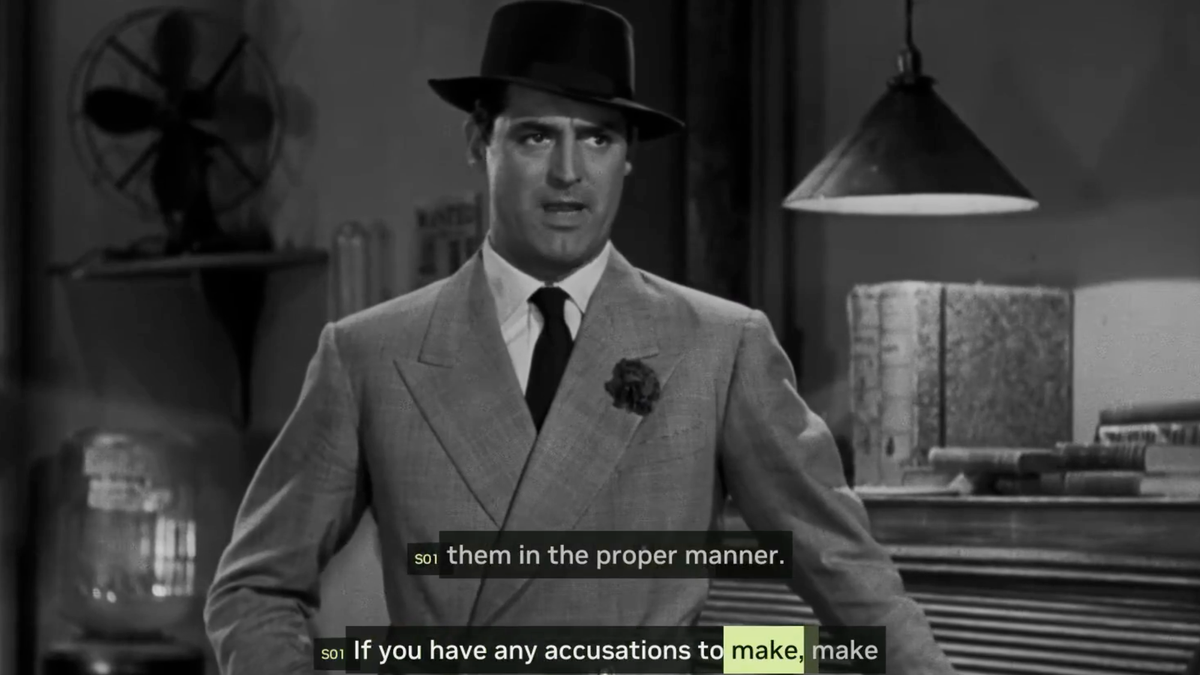
NVIDIA has released Nemotron 3.5 Transcribe, an open-weight speech model that handles transcription, speaker labels, translation and audio understanding in a single model. It supports 40 languages, and NVIDIA’s pitch focuses on one of the hardest parts of transcription: tracking who said what when people talk over each other.
The model is free to download on Hugging Face and cleared for commercial use. There’s also a live demo for testing it on your own recordings.
What It Does
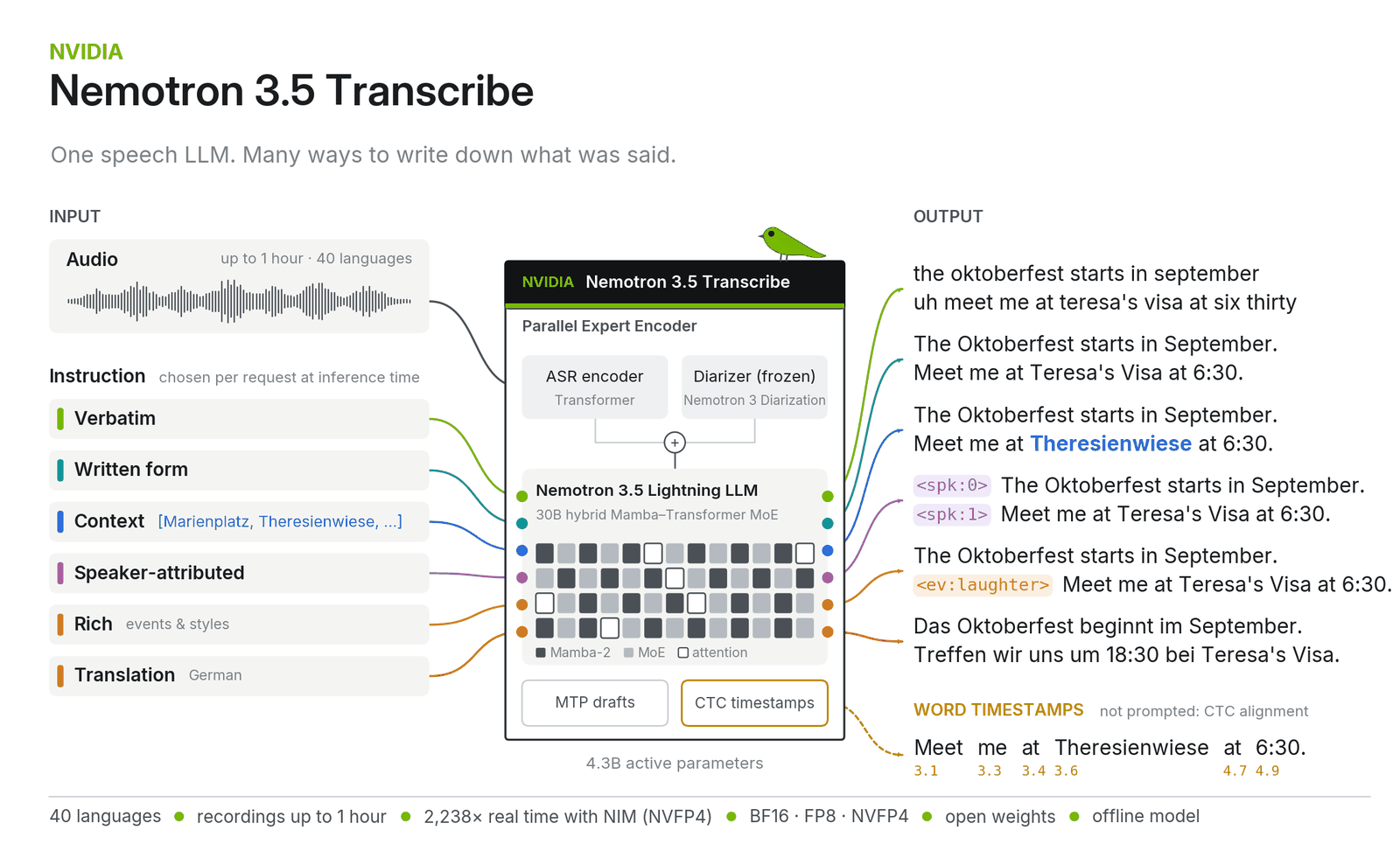
Nemotron 3.5 Transcribe is promptable, meaning you give it a recording and tell it what you need. In NVIDIA’s demo, a meeting recording gets speaker labels, is translated into Spanish and then Japanese, and has personal information found and redacted, all from the same model.
It processes recordings up to one hour long and returns word-level timestamps with speaker tags. Under the hood, it’s a 30-billion-parameter mixture-of-experts model with about 4 billion parameters active at a time, which keeps it relatively efficient for its size.
Why Editors Should Care
Meet NVIDIA Nemotron 3.5 Transcribe 🎙️
— NVIDIA AI (@NVIDIAAI) October 28, 2026
An open-weight, promptable 30B MoE model with ~4B active parameters that brings transcription in 40 languages, speaker attribution, translation, contextual prompting and audio understanding into one checkpoint.
Watch it keep track of who… pic.twitter.com/PEH1PeURIv
For documentary, interview and reality editors, overlapping dialogue is where most transcription tools fall apart. Speaker labels drift, crosstalk gets merged into one line, and fixing it by hand eats hours.
NVIDIA says Nemotron 3.5 Transcribe ranked first in VoiceArena’s 14-system comparison of speaker separation and transcription, and first on David AI’s multilingual speaker-separation benchmark. If that holds up on real interview audio, it would mean cleaner transcripts for paper edits, string-outs and subtitles.
Translation in the same pass could also help productions working with multilingual interviews, giving editors a working translation alongside the original transcript.
The Benchmarks
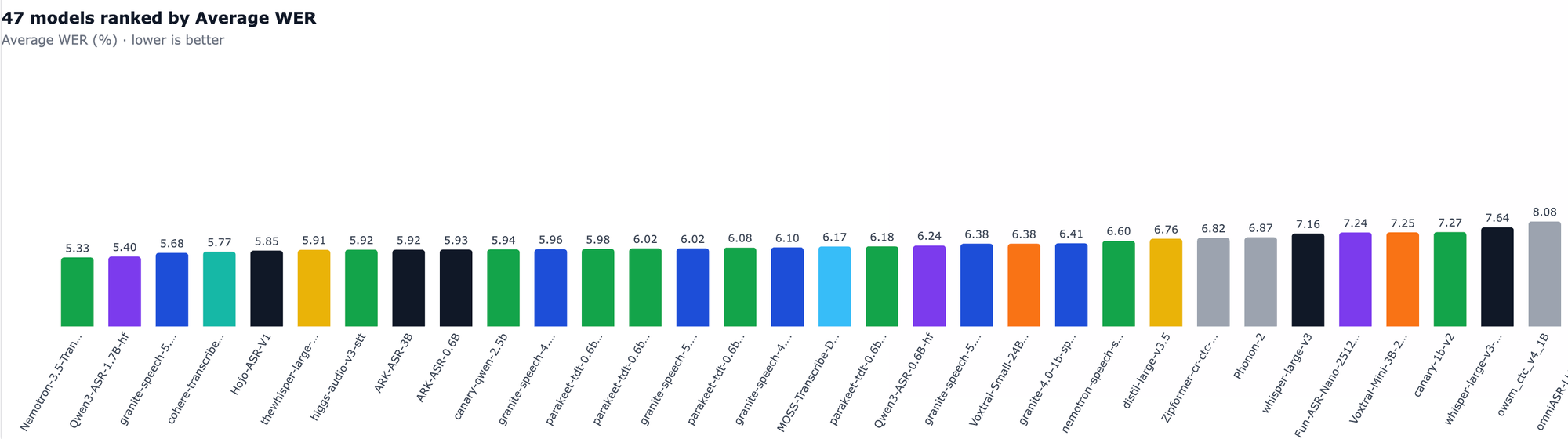
According to NVIDIA, the model ranks first among open-weight models on Hugging Face’s Open ASR English leaderboard, with a 5.33% average word error rate. On Artificial Analysis, it scores a 2.81% word error rate, close to Mistral’s Voxtral Small at 2.77%, while using about one-sixth the active parameters.
Benchmarks are measured on test datasets, not your footage. Accents, room noise, lav rustle and heavy crosstalk can all change results, so testing it on your own material through the free demo is the best gauge.
The Catch: Hardware
Running the model yourself is not a laptop job. NVIDIA’s deployment target is a single H100 80GB data center GPU, and the supported hardware list starts at high-end cards like the RTX 5090 and RTX PRO 6000.
The model card lists Linux and Windows support and doesn’t mention Macs or Apple Silicon. It’s also built for developers: setup runs through command-line tools like vLLM and NVIDIA’s NeMo framework, and output comes as text and timestamp data rather than ready-made subtitle files.
For most editors, the practical path is the Hugging Face demo for now, or waiting for transcription apps and services to build on the open model.
Competitive Context
Most editors already have built-in transcription. Premiere Pro, DaVinci Resolve and Descript all generate transcripts inside the edit, and some of them detect speakers.
On the open-model side, OpenAI’s Whisper has been the default for years. Mistral released Voxtral 3 earlier this month, and NVIDIA is pitching Nemotron as nearly as accurate at a fraction of the active compute. ElevenLabs and other paid APIs also compete on speaker labeling.
The Signal in the Noise
Nemotron 3.5 Transcribe matters less as something editors will install today and more as a sign of where transcription is heading. Speaker separation, translation and redaction are moving into one free, open model that any app developer can build on.
That likely means better transcription inside the tools editors already use. Until then, the free demo is the easiest way to see whether it handles your messiest interview audio better than what you’re using now.
What’s the hardest audio you’ve had to transcribe? Share which tools have actually handled crosstalk well in the comments.
Specs & Pricing
- Model: NVIDIA Nemotron 3.5 Transcribe (30B-A4B)
- Price: Free, open weights
- License: OpenMDW-1.1; commercial use permitted
- Languages: 40
- Max recording length: About one hour
- Features: Transcription, speaker labels, translation, contextual prompting, word timestamps
- Hardware: H100 80GB target; also supports A100 80GB, L40S, RTX 5090, RTX PRO 6000 and others
- Platforms: Linux and Windows; no Mac support listed
- Try it: Free live demo on Hugging Face