Peacock's New AI-Generated Detective Game Is a Real Test of "AI With Guardrails"
Peacock launched Public Eye, an AI-generated detective game from Dick Wolf's son. Here's how it compares to Roku's rockier AI content bet, and why the reception might actually be different.

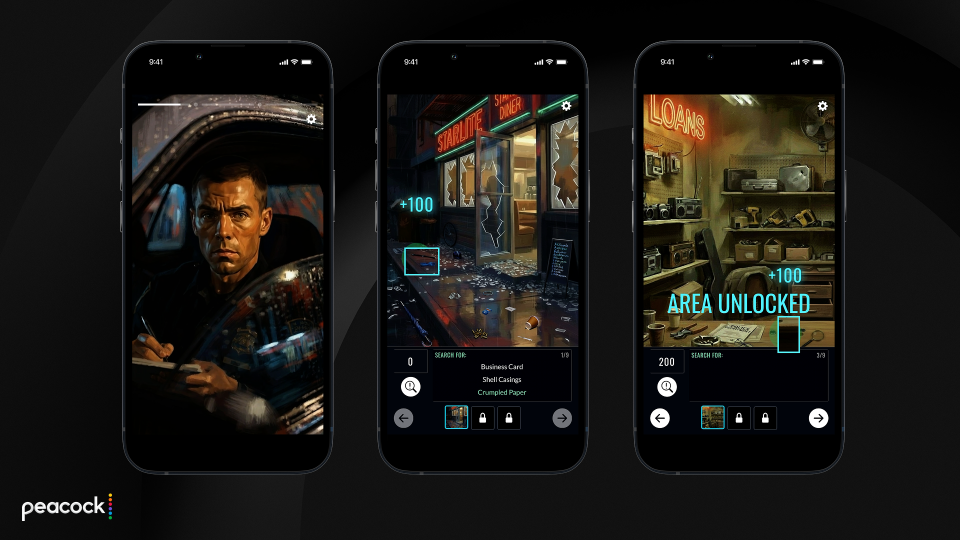
NBCUniversal's Peacock app launched Public Eye this week, a 10-episode AI-generated detective mystery from Wolf Games, the generative AI startup co-founded by Elliot Wolf, son of Law & Order creator Dick Wolf. It's a genuinely useful counterpoint to Roku's rocky Fairground AI channel launch covered here previously: same underlying bet on AI-generated entertainment, a notably different execution model and, so far, a notably different reception.
What Public Eye Actually Is
Players take on the role of Officer Logan Dine, a patrol cop secretly investigating his uncle's murder across the crime-ridden streets of the fictional Caldera City. Each of the ten episodes combines narrative storytelling with puzzle-driven hidden-object gameplay, searching AI-generated animated scenes for clues that gradually reveal a conspiracy running through the entire police department. NBCUniversal describes it as sitting at the intersection of two trends: microdramas and interactive storytelling, letting players actively drive a mystery forward rather than passively watching one unfold.
The Company Behind It

Wolf Games was co-founded by Elliot Wolf alongside CEO Andrew Adashek and CTO Noah Rosenberg, and raised a $4 million seed round backed by Dick Wolf himself, along with Jimmy Iovine, Paul Wachter, Maverick Carter, Tom Werner, and artist Rashid Johnson. The company uses generative AI, including Google's Gemini, to produce storylines, video-style character interviews, and still imagery for its games.
Wolf Games has been explicit about positioning itself differently from other AI content companies, stating its "focus on using ethical generative AI was a key driver" in the NBCUniversal partnership, and describing itself as not "focused on reinventing how traditional television and film are made," but instead engineered as "a true creative partner" with deep attention to story logic, character integrity, and world-building. That's a meaningfully different pitch than an AI-native studio generating standalone content: this is an established TV franchise family building tools specifically to extend existing IP into an interactive format, with human creative oversight built into the description of the product itself.
Real Engagement Numbers, Not Just a Launch Announcement
This is worth taking seriously as an actual data point rather than a promotional claim. Peacock reports that 40% of its mobile users engaged with a game on the app in June, and Law & Order: Clue Hunter, Wolf Games' earlier title built around the same core mechanic, has players averaging more than six minutes a day in the game, described by NBCUniversal as one of Peacock's most successful game launches to date. Public Eye is launching into a platform where this exact format has already demonstrated real, sustained engagement, not an unproven experiment.
Why the Comparison to Fairground AI Matters

Roku's Fairground AI channel, covered here previously, faced immediate, sharp criticism for broken physics, stilted dialogue, and incoherent scene structure, despite genuinely polished individual visuals. Public Eye is a meaningfully different execution of the same underlying bet on AI-generated entertainment: built by a team with deep, existing genre storytelling credibility (the Law & Order franchise specifically trades on procedural mystery structure), integrated into an existing successful game format on the same platform, and explicitly marketed around human creative oversight rather than fully autonomous generation.
Whether that combination actually produces a better result is something worth judging on the finished product rather than the pitch, but it's a genuinely different bet than Fairground's approach of sourcing creators directly from social media with less structural connective tissue between projects.
The Real Tension Worth Watching
NBCUniversal's own framing, extending "biggest franchises beyond passive viewing and into active participation," is explicitly about deepening engagement with existing IP and driving daily habitual usage inside the Peacock app, a real business goal distinct from Fairground's ad-supported, always-on content model. That's a genuinely different use case for generative AI in entertainment: not replacing traditional film and TV production, but building an entirely new interactive layer around it.
The commercial question worth watching, flagged directly by earlier coverage of Wolf Games: Public Eye is free with in-game purchases, and AI generation replaces the developers, artists, and voice actors a traditional game studio would otherwise need, redirecting that budget toward compute costs instead. Whether that economic model produces a sustainable return, especially against genuinely popular free daily games like Wordle or Connections in the same "quick daily engagement" category, remains an open question independent of how the content itself performs.
Competitive Context

This adds a distinct data point to how major media companies are approaching generative AI in entertainment right now: not a wholesale content-generation bet like Fairground AI, but an interactive-format layer built on top of existing franchise IP, backed by a real creative team with direct genre credibility. It's a notably different risk profile than an AI-native studio building standalone content from scratch.
The Signal in the Noise
The real test here isn't whether Public Eye can be made, generative AI clearly can produce this kind of content now. It's whether "AI with real creative oversight, built by people who actually understand the genre" produces a meaningfully different audience reception than the rougher, more autonomous approach that got Fairground AI mocked almost immediately after launch. Given Clue Hunter's already-demonstrated engagement numbers on the same platform, Wolf Games enters this test from a stronger starting position than most AI content ventures currently have.
Have you tried any of Peacock's AI-generated mobile games yet? Curious how the actual experience compares to the pitch, drop it in the comments.