Pika's API Club Takes Aim at the 3x Markup on AI Model Aggregator Platforms
Pika launched a $10/month API Club, undercutting aggregators like Fal and Runway Dev by up to 87% across 100+ AI models. Here's how the pricing actually compares.

Pika, known for its own Pika video generation models, launched something different this week: the Pika API Club, a $10/month membership giving developers discounted access to over 100 third-party generative media models, video, image, audio, and LLM, through a single API. It's a direct entry into the aggregator space this beat has been tracking, alongside fal, kie.ai, and Runway's developer API, and Pika's pitch is explicitly about undercutting them on price.
Why Pika Says It Built This
Pika's own framing is blunt: "We were shocked by the 3x markup by many API aggregation platforms. So we built our own, negotiated better prices, and kept our markup as low as possible to pass the savings on." That's a direct shot at the existing aggregator market, not just a new product announcement, and it positions Pika as a price disruptor in a category it wasn't previously competing in at all.
What the Discounts Actually Look Like
Today, we’re proud to introduce the Pika API Club—a membership that gets you access to the leading gen media models at previously impossible prices.
— Pika (@pika_labs) August 4, 2026
We were shocked by the 3x markup by many API aggregation platforms. So we built our own, negotiated better prices, and kept our… pic.twitter.com/d3xrl9qUfd
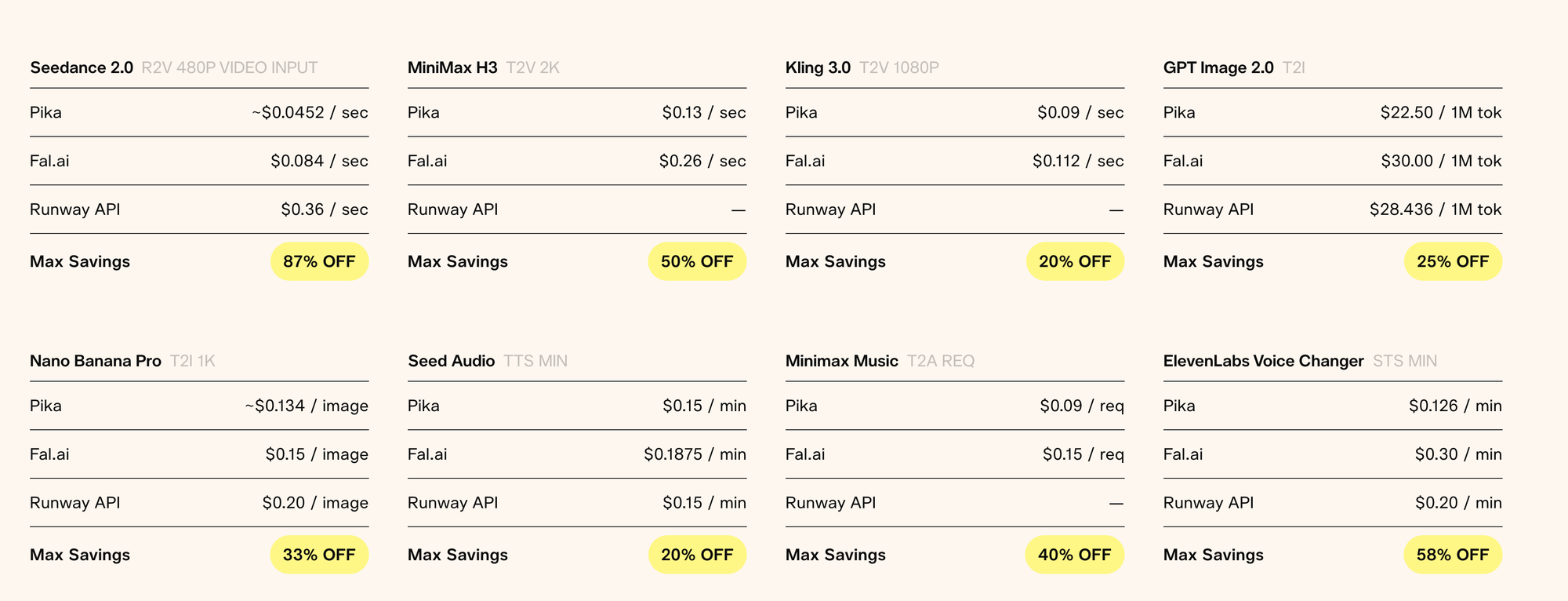
Pika published a specific pricing comparison against Fal.ai and Runway's API, and the numbers are worth citing directly. On Seedance 2.0 (480p), Pika lists roughly $0.0735/second versus Fal's ~$0.14/second and Runway API's ~$0.36/second, up to 80% savings. On MiniMax H3 (2K), Pika is $0.13/second against Fal's $0.26/second, a 50% discount. Kling 3.0 (1080p) runs $0.09/second on Pika versus Fal's $0.112/second, a smaller but real 20% gap. GPT Image 2.0 shows $22.50 per million tokens on Pika against $28.44–$30.00 elsewhere, up to 25% off.
Smaller discounts appear elsewhere: Nano Banana (image) at 16% off, Seed Audio at 20% off, MiniMax Music at up to 40% off, and Gemini Omni at 20% off. Pika explicitly noted these prices were recorded as of the announcement date and are subject to change as underlying provider costs shift, worth checking current rates directly before budgeting around any specific figure.
Worth Understanding About the Structure
The $10/month membership fee is the mechanism that makes the lower per-model pricing possible, Pika is trading a small recurring fee for negotiated volume pricing across its catalog, then passing much of that savings to members rather than keeping it as pure margin the way a higher-markup aggregator might. Runway API notably shows blank ("—") pricing on several models in Pika's own comparison table, MiniMax H3, Kling 3.0, and MiniMax Music specifically, suggesting Runway doesn't currently offer those particular models through its developer API at all, a data point about catalog breadth as much as pricing.
Pika also says it's committed to keeping pricing fully transparent, including cases where it's more expensive than a competitor. That's a notably different posture than most vendors take, and worth watching whether it holds up as the catalog and pricing evolve.
Where This Fits in the Landscape
This is a genuinely useful addition to understanding the broader AI model landscape: Pika now occupies a dual role, a model builder in its own right (Pika 2.x and beyond) and a wrapper/aggregator reselling access to more than 100 competitors' models through one API. That's not a contradiction, plenty of platforms in this space play both roles, but it's worth keeping straight when comparing prices: "Pika" pricing on a Seedance or Kling model has nothing to do with Pika's own model quality, it's purely about markup and negotiated rates on someone else's model.
Competitive Context
This puts Pika in more direct competition with the developer-facing platforms already covered on this beat, fal, kie.ai, WaveSpeedAI, and Runway's own API, all of which compete primarily on price and catalog breadth rather than building their own frontier models. Whether Pika's negotiated rates hold up as sustainably lower long-term, rather than an introductory pricing push, is worth watching over the next few months.
The Signal in the Noise
For developers or studios building products on top of multiple AI models, a $10/month membership unlocking meaningful, transparent discounts across 100+ models is a genuinely useful option to know about, provided the pricing holds. The bigger pattern worth noting: as more platforms compete specifically on aggregator markup rather than model capability, it's becoming increasingly clear that the "which app should I use" question this beat has been tracking often comes down to negotiated pricing and catalog access more than any meaningful technical difference between providers reselling the same underlying models.