A New LoRA Turns Clean AI Footage Into Damaged '80s Broadcast Tape
A new LoRA turns MiniMax H3's clean output into damaged 1980s VHS broadcast footage, complete with matching degraded audio.

A small, carefully built LoRA called vh5tape does something specific: it makes MiniMax H3's clean, modern output look like it was recorded off 1980s broadcast television onto a VHS tape that's been rewound one too many times. Soft smeared detail, chroma bleed, tracking noise, head-switching bands at the frame edge, and because H3 trains audio and video jointly, matching muffled mono sound, tape hiss, and warble too.
A Deliberately Designed Damage Dial
Rather than a single fixed "VHS filter" look, creator KennethFal built three trained damage tiers, controlled entirely through the prompt: a light, gentle analog glow; a medium level with visible tape wear; and a heavy setting pushing toward a tape the VCR can barely hold onto. That's a meaningfully more deliberate design than a blanket style LoRA, it treats "how damaged" as a creative parameter worth controlling precisely, not an all-or-nothing toggle.
The audio behavior is the more unusual detail. Because H3 generates video and audio together rather than as separate passes, describing audio characteristics in the prompt, muffled mono, canned laughter, a cheesy jingle, actually renders as tape-appropriate degraded sound to match. Dialogue given as short, explicit quoted lines reportedly comes through near-verbatim too, letting a scene carry actual period-accurate voiceover rather than just a visual effect layered over silence.
Built With the Exact Tool We Already Covered
This LoRA was trained using fal's MiniMax H3 LoRA trainer, the same tool BRC covered when it launched, at rank 32 for 5,000 steps on a small, hand-curated dataset of four-second clips pulled from period broadcast material: sitcoms, soap operas, commercials, news segments, and station sign-offs.
One genuinely interesting methodological note from the training writeup: the 5,000-step checkpoint beat versions trained for 2,000 through 6,000 steps in blind A/B testing, additional training past that point made the tape damage look tamer, not heavier, an outcome that isn't necessarily intuitive if you'd assume more training time simply means a stronger effect.
The LoRA works directly on both of fal's LoRA-compatible H3 endpoints, the standard H3 model and H3 Max, the speed-optimized version BRC covered separately, giving it a real, practical path into fast, iterative use rather than sitting as a one-off research artifact.
Why Someone Actually Built This
The project traces back to something more personal than a general-purpose tool release: KennethFal describes it as built for "H3-TV," a simulated 1970s portable CRT rebuilt to play an endless, slightly wrong 1980s broadcast day. That's a genuinely specific creative vision, not a broad commercial play, and it shows in the craft of the LoRA itself: purpose-built for a particular aesthetic project rather than a generic "make it look old" tool.
The Signal in the Noise
This is a small release, a few dozen downloads, a handful of likes, but it's a useful, concrete example of what the MiniMax H3 ecosystem's infrastructure actually produces once real people start building on it.
The base model, the open-source Mac inference engine, the LoRA trainer, and the speed-optimized H3 Max endpoint all exist as separate pieces of coverage on their own. This is what happens when someone strings them together toward a specific creative goal, a level of craft and control over a very particular aesthetic that would have been genuinely difficult to achieve with a generic prompt alone.
Would a tool like this change how you think about using AI video for a deliberately retro or degraded look, versus trying to approximate it entirely in post?
The Details
- LoRA: vh5tape, style LoRA for MiniMax H3, created by KennethFal
- Effect: simulates worn 1980s VHS broadcast recording, with matching degraded mono audio
- Damage control: three trained tiers (light, medium, heavy), set via prompt phrasing
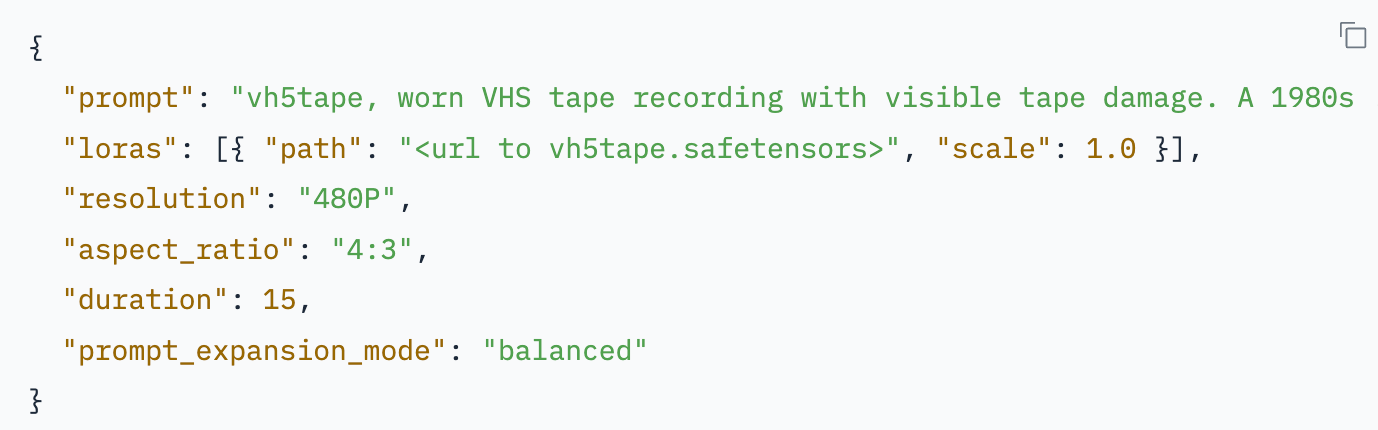
- Training: fal's MiniMax H3 LoRA trainer, rank 32, 5,000 steps, 4:3 aspect ratio, joint video+audio training
- Training data: small hand-curated set of four-second period broadcast clips
- Compatible endpoints: fal's standard MiniMax H3 and H3 Max LoRA endpoints
- License: MiniMax H3 Community License
- Project context: built for "H3-TV," a simulated CRT playing an endless AI-generated 1980s broadcast day