This Creator Built a Custom AI Storyboard Pipeline Using Fable 5 (Before It Was Abruptly Shutdown)
Benjamin Springer completed a custom automated storyboard pipeline just before AI generation platform Fable 5 was shut down. The tool chains LLM, text-to-image, and image-to-video models into a single pre-production workflow.

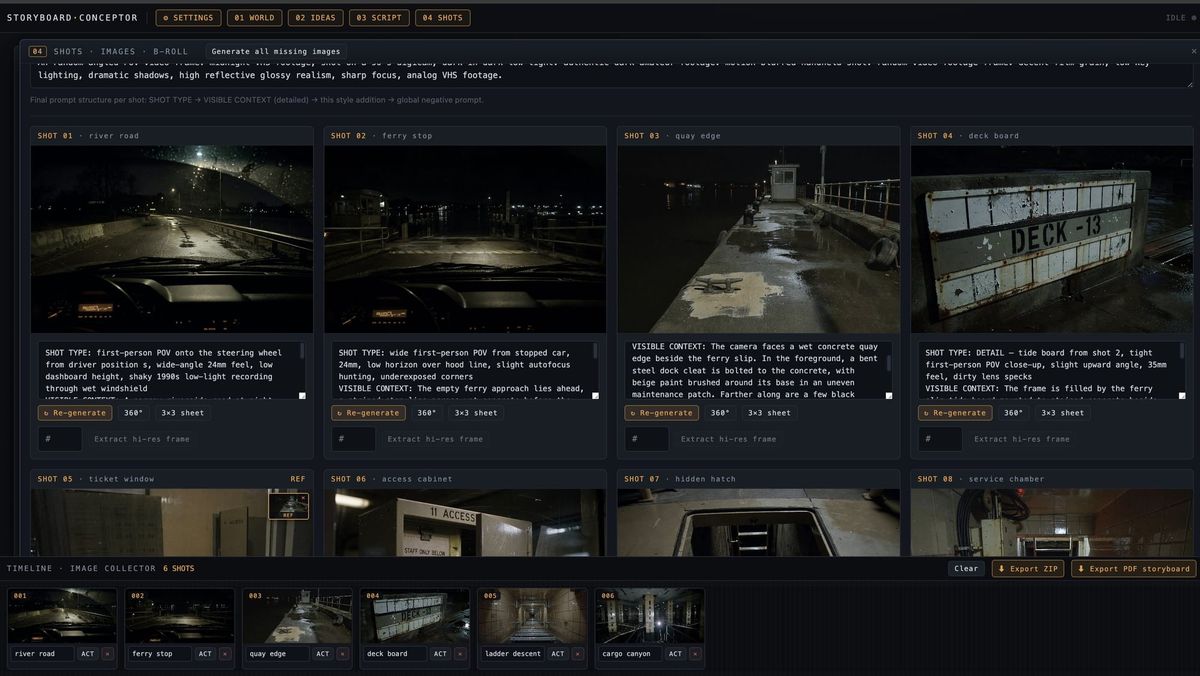
Filmmaker and creator Benjamin Springer announced on X this week that he finished building a fully automated, custom storyboard creation tool — completing development just before the AI generation platform Fable 5 was unexpectedly shut down. The timing underscores a growing risk for creators who rely on third-party AI platforms that can disappear without notice.
How the Pipeline Works
Springer's workflow follows a straightforward chain he describes as: Idea -> LLM -> T2I -> I2V = Film. A user writes a concept, a large language model structures it into a guided storyboard, text-to-image models generate consistent visual frames, and an image-to-video model renders the final output.
The tool outputs consistent character and shot continuity across multiple cuts, B-roll footage, and 360-degree panoramas. Environmental and panorama rendering is handled using Seedance 2 as the ground-truth model for that stage of the pipeline.
"Right before fable 5 was shut down, I finished my custom automated storyboard creator," Springer wrote on X. "You just write the idea and it's guided through the final storyboard with consistent shot outputs."
Competitive Context
Established storyboarding tools like Storyboarder and Toon Boom Storyboard Pro have long owned the pre-visualization space. Neither connects directly to generative video output, which is exactly the gap Springer's pipeline targets.
Several AI-native tools have attempted to build end-to-end pre-production pipelines, but the Fable 5 shutdown is a reminder that the field is still consolidating. Creators who built workflows on top of Fable 5 now need to rebuild. Springer's approach — owning the full stack rather than depending on a single platform — is a direct response to that volatility.
Seedance 2, the model Springer uses for panorama rendering, is a notable choice. It signals that creators are mixing and matching best-in-class models for specific tasks rather than committing to one provider's full suite.
The Signal in the Noise
The Fable 5 shutdown is the real story beneath the workflow reveal. When a platform disappears overnight, any pre-production work built on top of it stalls or breaks entirely. Springer's custom build exists precisely because that kind of disruption is now a recurring event in AI tooling.
For independent filmmakers, the practical takeaway is that multi-model pipelines stitched together yourself carry more long-term stability than any single platform. If one model goes dark, you swap it out — you don't lose the whole workflow.
Consistent character output across shots remains one of the hardest problems in AI-assisted pre-production. Springer's claim that his pipeline handles this is worth watching closely. No external demos or sample outputs have been shared publicly yet, so that claim is still self-reported.
Specs & Pricing
Springer's pipeline is a custom-built private workflow, not a commercial product. No pricing or public release has been announced. The tool integrates an unspecified LLM, a text-to-image model, Seedance 2 for panorama rendering, and an image-to-video model. Follow Benjamin Springer on X at @Ben__Springer for updates on availability or a potential public release.