Meta Enters the AI Video Race With Muse Image and Muse Video
Meta just launched Muse Image and previewed Muse Video — its first AI media generation models from Meta Superintelligence Labs. Here's what's new, what the Instagram training data means, and where it sits on the benchmarks.

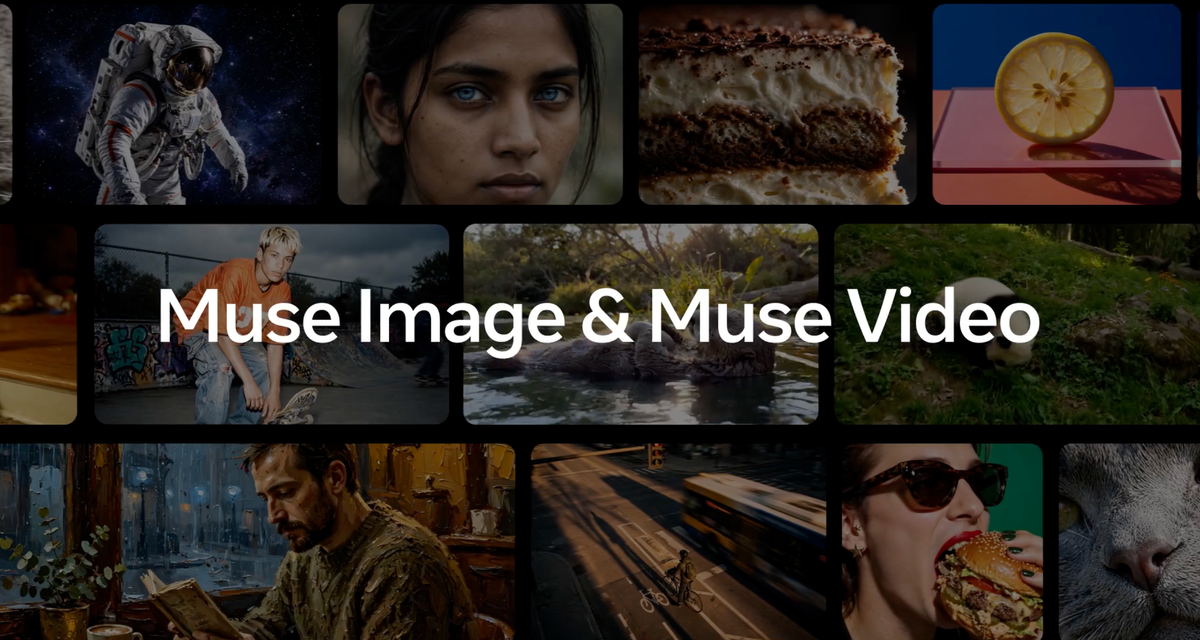
Meta just launched Muse Image and previewed Muse Video — the first media generation models from its newly formed Meta Superintelligence Labs division. Both are live or incoming across Meta's product suite: Muse Image is available now in the Meta AI app, on meta.ai, in Instagram Stories in the US, and in WhatsApp in limited countries. Muse Video is coming soon to creators and Meta AI.
For context on the "Superintelligence Labs" name: this is an internal Meta division, not a separate company. It's the team now leading Meta's most advanced AI model development, and Muse is its first public output.
What Muse Image actually does differently
Introducing Muse Image and Muse Video, the first media generation models developed by Meta Superintelligence Labs.
— AI at Meta (@AIatMeta) July 7, 2026
Muse Image is our most advanced image generation model yet. It follows instructions faithfully, edits with precision, composes from multiple references, and draws… pic.twitter.com/byNpQZO1RW
Most image generation models take a prompt and map it directly to an output. Muse Image operates differently — it functions as an agent, using tools to improve its own outputs rather than generating in a single pass. Specifically, it can invoke web search to ground generated images in real-world facts and current events, write and execute code to produce accurate charts, QR codes, and embedded figures, and self-refine its own generations mid-process — discarding a draft and starting over, or making a targeted local edit, based on its own assessment of what's wrong.
Meta says this self-refining behavior wasn't explicitly designed — it emerged during reinforcement learning training because self-refinement produced better images and therefore higher reward. The model also supports multi-reference image composition, pulling elements from multiple input images (people, objects, clothing, styles, environments) into a single generated output.
On the Arena human-preference leaderboard as of July 5, Muse Image holds the number two spot for text-to-image, single-image editing, and multi-image editing.
The Instagram angle worth knowing
The detail in Meta's announcement that's most likely to land differently depending on who's reading it: Muse Image draws on Instagram for social context. Meta's framing is that this helps the model understand visual trends, styles, and real-world social imagery. The less comfortable read is that Instagram's entire corpus of user-uploaded photos — billions of images uploaded by creators, photographers, and filmmakers over more than a decade — is functioning as training data for a commercial AI product. Meta's terms of service have been updated to reflect this, but it's worth knowing before you use the tool to generate imagery and before you think about what your own Instagram archive is being used for. sec
Muse Video: preview only, but the benchmark position matters
Alongside the release of Muse Image, we’re sharing an early preview of Muse Video. It offers competitive performance in prompt adherence, visual fidelity, and temporal consistency.
— AI at Meta (@AIatMeta) July 7, 2026
We’re investing in areas with current performance gaps, such as audio-video synchronization and… https://t.co/kftRoTgq6W pic.twitter.com/iIFeFGLzoE
Muse Video is a preview — not a full release — built on the same pretraining base as Muse Image, with native audio support and what Meta describes as competitive performance in prompt adherence, visual fidelity, and temporal consistency. Meta is explicitly flagging current performance gaps in audio-video synchronization and physically accurate fast motion.
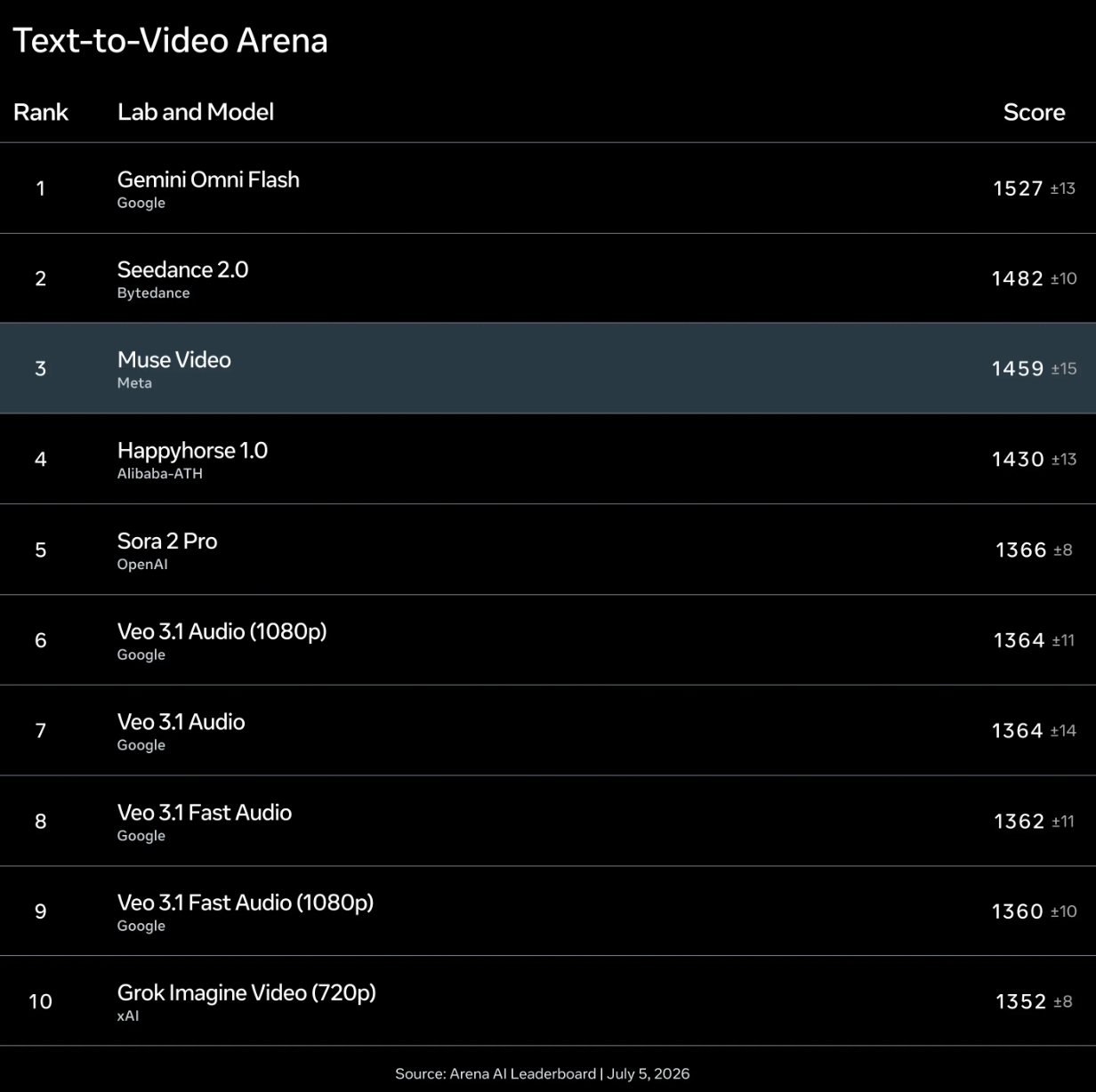
On Arena's text-to-video leaderboard as of July 5, Muse Video already ranks number three in human-preference Elo — a notable position for a model that isn't fully released yet. For context on what that benchmark means: Seedance 2.0 (currently number one) and the models near the top are the same ones we covered in our AI video model ranking last week. Muse Video entering at number three before a full launch suggests Meta is coming in with serious capability rather than a placeholder.
Content Seal: the watermarking system built in
Every image generated by Muse Image carries Content Seal — an invisible watermarking system that Meta says survives cropping, compression, resizing, and screenshotting. A detection tool is being previewed alongside the launch that lets anyone check whether an image carries a Content Seal watermark. Meta plans to extend this to video.
For filmmakers and creators thinking about AI-generated content in professional contexts, this is the most practically relevant part of the launch: every Muse Image output is permanently marked, and that mark is designed to survive the most common ways people try to strip watermarks.
Competitive Context
Meta entering AI media generation with a top-two image model and a top-three video preview — while also having Instagram as a distribution surface that immediately puts these tools in front of hundreds of millions of users — is a different kind of market entry than a standalone AI company launching a new model. The distribution advantage alone is significant. Where Veo 3.1 requires finding it through Runway or Google AI, and Kling requires a separate account, Muse Image is already inside Instagram Stories for US users today.
The Signal in the Noise
The AI image and video generation space just got meaningfully more crowded at the top. Meta has resources, distribution, and a training dataset (Instagram) that no other player in this category has. Whether Muse Image and Muse Video ultimately displace the current leaders — Veo, Kling, Runway — depends on how quickly the video side closes its acknowledged performance gaps and whether Meta's Instagram integration translates into actual creator adoption. But the entry is serious, the benchmark positions are real, and the distribution advantage is immediate.