Four Ways to Light a Scene Without Your Gear Showing Up On Screen
Filmmaker Mark Bone's four techniques for lighting a scene without visible gear: controllable LED practicals, window punching, overhead rigging, and hand-bombing. Here's how each works and when to use it.

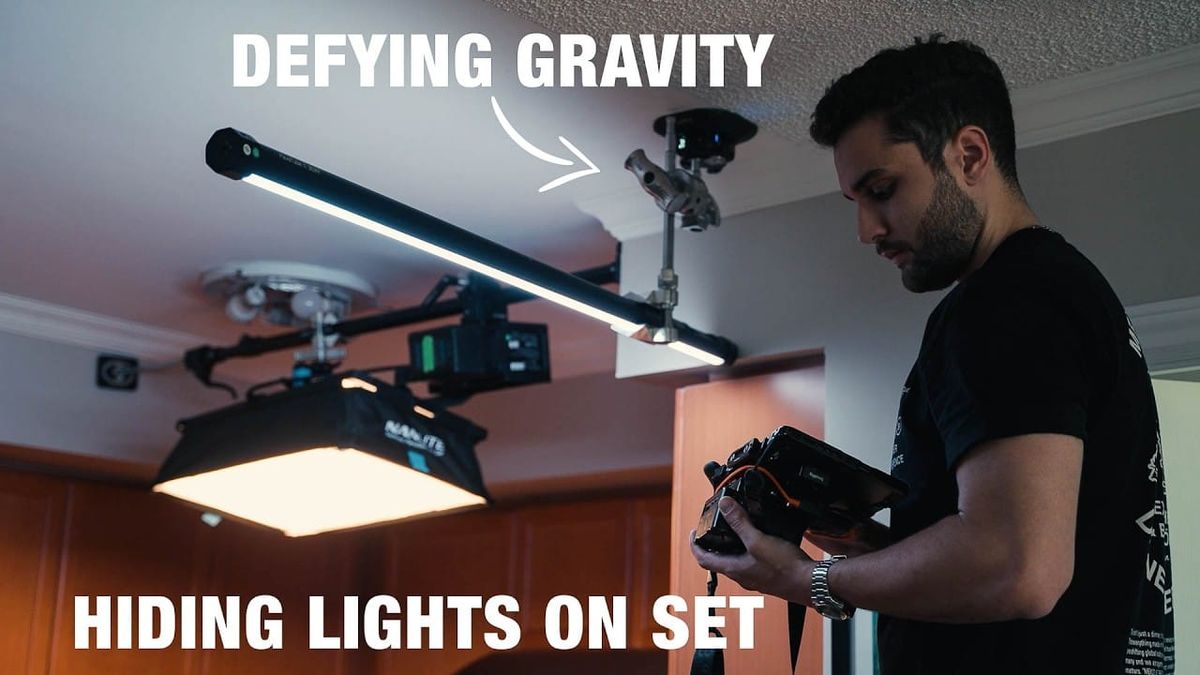
The best lighting on a documentary set is lighting the subject doesn't notice. Filmmaker Mark Bone builds his approach around a simple principle: fewer visible lights on set means better performances from non-actors, and more freedom for the camera.
His four techniques for achieving that without sacrificing image quality are practical, low-footprint, and applicable well beyond documentary work.
1. Practicals as Controllable Light Sources
The first technique is the most straightforward: use lamps and practical fixtures that already exist in a location as actual light sources, not just set dressing.
The limitation of most practical bulbs is controllability — a standard household LED runs at a fixed color temperature and brightness that rarely matches what the scene needs. Bone's solution is to replace stock bulbs with controllable LED alternatives. His specific recommendation is the Pavo 10C, a controllable LED bulb that allows color temperature and brightness adjustment from a phone or control system while sitting inside a standard lamp socket.
The result is a light source that reads as part of the environment — a lamp that belongs in the room — while actually functioning as a cinematographer-controlled fixture. No stands, no cables running to a dimmer, no visual indication to the subject that the lamp is doing anything other than being a lamp.
2. Punching Light Through Windows From Outside
The second technique uses the exterior of a location to source light through windows, keeping all grip equipment outside the frame entirely.
Bone's specific approaches: positioning a fixture outside a window to push light through the glass into the interior, using foliage — what cinematographers call "dingles" — in front of the light source to break up the beam and create naturalistic dappled light, and bouncing light off the floor just inside the window to produce a soft, indirect fill that reads as ambient rather than artificial.
The gear he uses for this: the Nanlux 600C (approximately $2,899) for situations where window distance requires output, and the Nanlux 150C (approximately $999) for closer placement. Both are battery-capable, which matters when there's no power source available at the exterior position.
Punching through windows also naturally solves one of the common problems with interior lighting: motivated direction. Light coming through a window has an obvious source, which makes it read as real. A light on a stand in the corner of a room has to work harder to justify itself visually.
3. Overhead Rigging With Polecats and Suction Cups
The third technique addresses tight spaces where floor-mounted stands aren't viable — small rooms, narrow corridors, locations where a stand in any position eats into usable camera angles.
Bone uses two approaches for overhead rigging. Polecats (autopoles) are spring-loaded poles that tension between floor and ceiling, allowing fixtures to be mounted overhead without any wall attachment. For smooth ceilings, the Tilta Hydra electronic suction cups mount fixtures directly to the ceiling surface — motorized suction that holds small LED panels overhead without any visible support structure in the frame.
The limitation of both approaches is fixture size and weight. Polecats and suction cup rigs work for smaller fixtures — panels, tubes, compact LEDs. They're not solutions for large softboxes or heavy fixtures. The Pavo Slim 360C and Pavo Tube 230XR are specifically mentioned as fixtures that work well in overhead rig configurations for this reason.
4. Hollywooding: Hand-Bombing Light Into Shots
The fourth technique is the most flexible and the most physically demanding: crew members holding lights or bounce cards on poles and following the action by hand.
Bone calls this "Hollywooding" — named for its long history in studio production. As he notes: "This technique you will see on huge Hollywood sets all the way up to projects like Wes Anderson's films." A grip holds a bounce card just outside the frame, angling it to throw fill light onto a moving subject. Another crew member holds a small LED panel on a pole, following an actor through a space while the camera moves with them.
The advantage over any rigged solution is responsiveness. A handheld light follows the action in real time without pre-programming or repositioning between setups. The disadvantage is that it requires crew, which means it doesn't scale down to solo or two-person shoots the way the other three techniques do.
For documentary specifically, Hollywooding has a practical advantage beyond the lighting result: it keeps the physical footprint on the ground minimal. No stands, no sandbags, no cables to trip over — a crew member holding a light takes up no more space than a person standing in the room.
Competitive Context
The underlying shift enabling all four of these techniques is the development of compact, battery-powered LED fixtures with high enough output to do real work. A Nanlux 600C pushing through a window is doing work that would have required a much larger, harder-to-position HMI a decade ago. Controllable LED bulbs in a lamp socket weren't viable until recently. The Tilta Hydra suction cup system addresses a specific rigging problem that previously had no clean solution.
Traditional lighting setups — C-stands, sandbags, heavy fixtures on the floor — aren't wrong. They're appropriate for controlled environments where footprint doesn't matter and the lighting can be set and locked. They're the wrong tool for documentary work in real locations, for productions where actors need to move freely, and for situations where the presence of visible grip equipment changes how subjects behave in front of the camera.
The Signal in the Noise
Bone's core observation is worth stating directly: "I always believe I'll get a better performance out of people who are non-actors when there is less lighting on set." That's not a technical claim about lighting quality — it's a claim about human behavior. Non-actors who are aware of being lit perform differently than non-actors who don't register the lighting at all. The invisible lighting setup changes the footage before the camera even rolls.
That principle extends beyond documentary. Any production where authentic behavior matters — narrative films with non-professional actors, branded content with real people, interview-based work of any kind — benefits from lighting approaches that don't announce themselves.
Specs & Pricing
Key gear from Bone's kit: Nanlux 600C approximately $2,899, Nanlux 150C approximately $999, Pavo Slim 360C and Pavo Tube 230XR (current pricing at aputure.com), Pavo 10C controllable LED bulb (current pricing at aputure.com), Tilta Hydra electronic suction cup system (current pricing at tilta.com). Camera used for testing: Arri Alexa. Lenses: Arcana Dizio. Current pricing on all Nanlux products at nanlux.com; Tilta products at tilta.com.
Resources & Reads
- Mark Bone's full video: https://www.youtube.com/watch?v=V6dCfknHTm8
- The Art of Documentary (free lighting guides and checklists): linked in Bone's video description
- Nanlux 600C product page: https://www.nanlux.com/product/evoke-600c
- Tilta Hydra suction cup system: https://tilta.com/product/tilta-hydra-alien-car-mounting-system/
- Aputure Pavo product line: https://www.aputure.com/collections/pavo