Is AI Filmmaking Legal? What Filmmakers Need to Know About Copyright in 2026
Is AI filmmaking legal? It's not one question. Here's where copyrightability, training-data lawsuits, and platform terms of service actually stand in 2026.


The honest starting point on this question: there isn't one clean answer, because "is AI filmmaking legal" is actually several different legal questions bundled together, and they're each at different stages of being settled. This isn't legal advice, and if you're making real decisions about a commercial project, talk to an actual entertainment or IP attorney. But here's the current, accurate landscape as of 2026.
Can You Actually Copyright an AI-Generated Film?
This part is genuinely settled, at least in the US. The Supreme Court declined to review Thaler v. Perlmutter in March 2026, leaving in place the US Copyright Office's "human authorship requirement": a work created entirely by AI, with no meaningful human creative control, cannot be copyrighted.
That doesn't mean every AI-assisted project is unprotectable. The Copyright Office's own guidance, reinforced by the 2023 "Zarya of the Dawn" case, draws a real distinction between AI output itself and the human creative choices layered around it. In that case, the human author retained copyright over her written text and the creative arrangement of AI-generated images in her graphic novel, but not over the AI-generated images themselves. The Office evaluates this case by case, looking at how much a human selected, arranged, modified, or exercised genuine creative control over the final work.
One detail worth knowing directly: the Office's own 2025 report states that prompts alone, no matter how detailed, are not enough to establish human authorship. Writing "cinematic wide shot, golden hour, character walks toward camera" and generating a clip doesn't make you the legal author of that clip's specific visual content. What likely does count: substantial editing, compositing multiple generations into an edited sequence, adding original dialogue or music, or otherwise exercising real creative control over the final work beyond the initial prompt.
Practically, this means a fully AI-generated short with no human editing is probably not copyrightable as a whole. A film built from AI-generated elements that a human then selects, arranges, edits, and combines with other original work has a real, defensible claim to copyright over that human-authored arrangement, even if the underlying AI-generated footage itself isn't separately protected.
Is It Legal for AI Companies to Train on Copyrighted Material?
This is the genuinely unsettled question, and it's not your problem directly as a filmmaker using these tools, but it affects the tools you're using in ways worth understanding.
Multiple major lawsuits are working through US courts right now: The New York Times v. OpenAI (a court has already rejected the argument that AI training is inherently transformative, and the case is heading toward trial), Disney and Universal v. Midjourney (three of the five major studios have now sued, consolidated into one case with discovery extending into late 2026), and Getty Images v. Stability AI, among others. Courts have split on outcomes so far, Meta won on fair use grounds in one case, while separate claims about how training data was actually obtained remain active.
The trend worth understanding: as more labs sign licensing deals with rights holders (Disney's OpenAI partnership, Warner and Universal's deals with Suno and Udio), the existence of a real licensing market makes it harder for other AI companies to argue fair use for training on unlicensed material. That's part of why you've seen a wave of AI companies rushing to sign licensing agreements recently, the legal ground under "train first, license later" is genuinely eroding, not holding steady.
For filmmakers, the practical takeaway isn't that using these tools is illegal, it's that the underlying legal risk sits with the platform, not with you as a user in most cases. But it's worth knowing that the tool you're building a workflow around could face real legal or business disruption depending on how these cases resolve.
What About the Platform's Own Terms of Service?
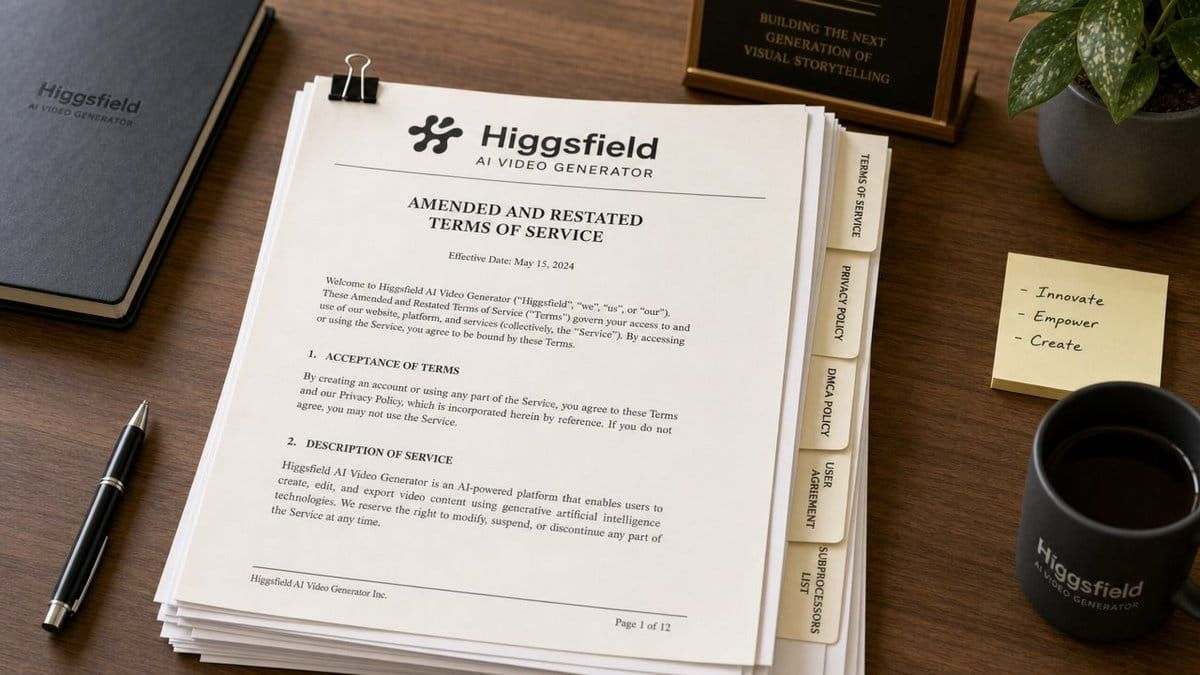
This is the part that actually affects you directly, and it varies significantly by platform, worth checking specifically rather than assuming.
Some platforms claim broad rights over content you upload or generate. Higgsfield's terms, for example, include a license permitting the company to use uploaded content, including reference images and outputs, for its own model training and promotion, a real consideration if you're uploading proprietary character designs or client material. Other platforms are more restrictive in different ways: MiniMax's H3 Community License explicitly excludes the US, EU, UK, and South Korea from its open-weights terms, meaning what's "legal" to do with a model can literally depend on your location. Bland's voice cloning requires the account holder to affirmatively confirm they hold rights to the voice being cloned, a real, enforced gate rather than an honor-system checkbox.
Before building any commercial workflow around a specific AI tool, actually read what happens to your uploads, who owns the output, and what commercial usage rights you're actually granted, these terms differ meaningfully platform to platform and change over time.
Voice, Likeness, and Deepfake Concerns
Separate from copyright, cloning a real person's voice or likeness without consent runs into right of publicity law, which varies by US state and by country, and increasingly into specific deepfake legislation being passed at the state level. This is a distinct legal category from copyright infringement, and it's often the more immediate risk for filmmakers using AI voice or face-generation tools on real people.
Suno's recent move to add watermarking and fingerprinting technology, covered here previously, is partly a response to this exact concern: platforms are under real pressure to prevent their tools from being used to impersonate real artists or public figures without consent. If your project involves generating a real person's voice or likeness, that's the area most likely to create actual legal exposure, more so than the copyright questions above.
What This Actually Means for You
If you're making an AI-assisted short for a portfolio, a festival submission, or a personal project, the practical risk is genuinely low. Use tools within their terms of service, don't clone real people without permission, and understand that fully AI-generated content may not be copyrightable as a standalone work, meaning someone else could theoretically use the same or similar AI-generated elements without infringing anything of yours.
If you're doing commercial work, client projects, or anything with real money involved, the calculus changes. Read the specific platform's terms of service for the tools you're using. Keep records of your creative decisions and edits, since that documentation is exactly what would establish human authorship if copyright protection ever mattered. And if a project involves real people's likeness or voice, or meaningful commercial stakes, an actual conversation with an entertainment or IP attorney is a reasonable cost against the risk, not an overreaction.
The Signal in the Noise
"Is AI filmmaking legal" doesn't have a single answer because it's not a single question. Making an AI film is legal. Whether you can copyright it depends on how much genuine human creative control you exercised. Whether the tool you used to make it was legally trained is a separate, unsettled question that's primarily the platform's legal exposure, not yours. And whether your specific project creates real risk depends heavily on whose voice or likeness you're using and what platform's terms you agreed to. None of that is settled enough to reduce to a yes-or-no answer yet, and treating it as more settled than it actually is, in either direction, is the real mistake to avoid.
Resources & Reads
- U.S. Copyright Office: Copyright and Artificial Intelligence, Part 2 — Copyrightability
- Suno Cracks Down on AI Music Fraud With New Watermarks and Download Limits — BRC
- MiniMax Open-Sourced H3 for Local AI Video, but Not Everyone Can Actually Use It — BRC
- What's the Actual Goal of AI Filmmaking Right Now? — BRC