AI Video Credits Explained: Why Every Platform Prices Differently
Why does "625 credits" mean 25 seconds on one AI video model and 125 on another? Here's what credits actually represent, and how to actually compare cost across platforms.


"625 credits a month" tells you almost nothing on its own. It could mean 25 seconds of video or 125 seconds, depending entirely on which model you're generating with, and that gap is exactly why comparing AI video platforms by subscription price alone is close to meaningless. Here's what credits actually represent, and how to actually compare cost across platforms.
What a Credit Actually Is

A credit is an abstraction layer over compute cost. Generating video is expensive to run, GPU time scales with resolution, duration, and model complexity, and rather than charging a different literal dollar amount for every possible combination, platforms convert that variable cost into a flat internal currency. You buy a bucket of credits, and each generation withdraws from that bucket at a rate the platform sets based on what that specific generation actually costs them to run.
That system benefits the platform more than it benefits you as a buyer. A subscription price is easy to compare across platforms. A credit-per-second burn rate buried in documentation is not, and that opacity is doing real work: it makes a $15/month plan sound comparable to another $15/month plan, even when one gets you 25 seconds of premium video and the other gets you 150.
The Same Platform, Wildly Different Rates
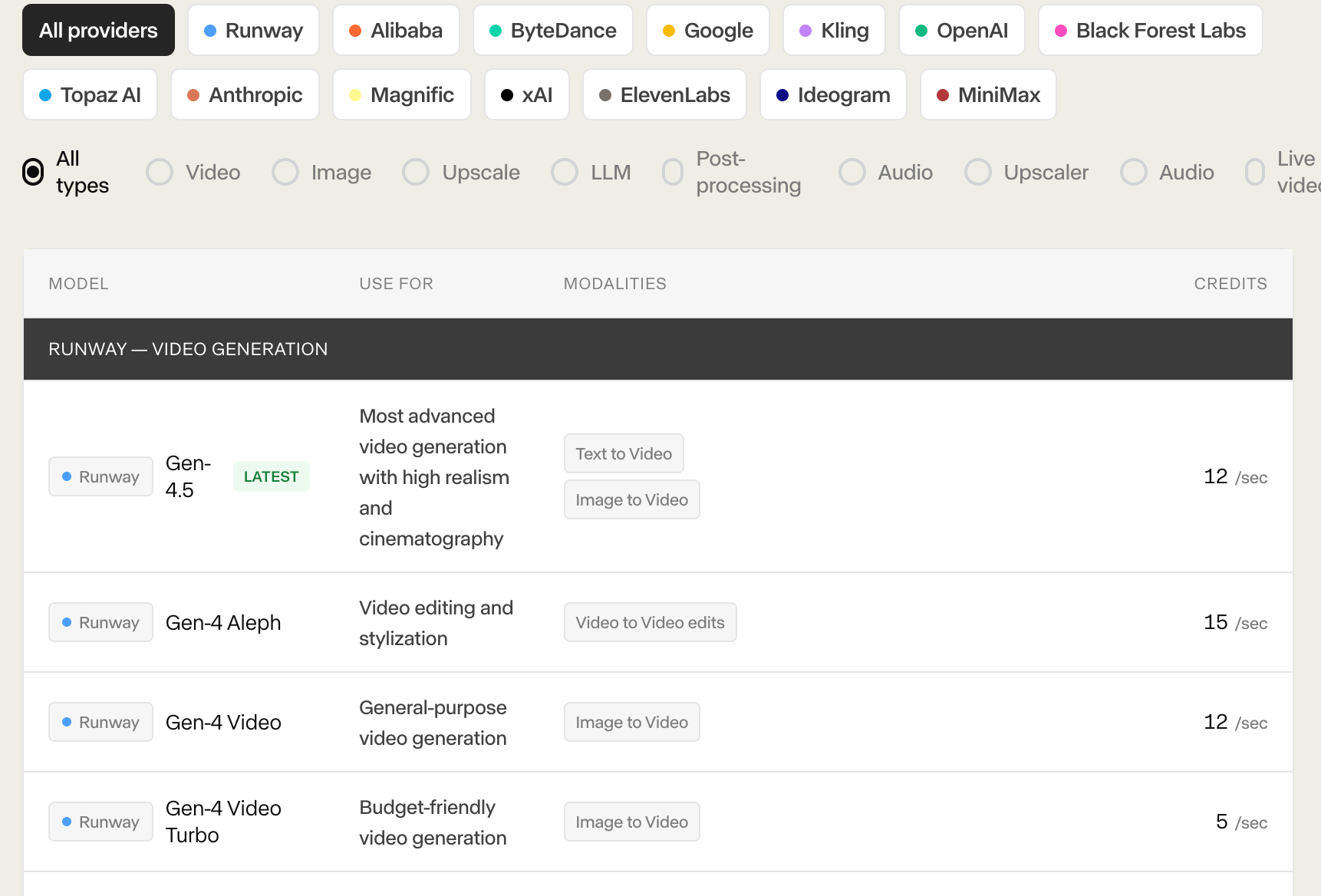
Runway is the clearest example of how much burn rate varies within a single platform. Its Standard plan includes 625 monthly credits, and what that actually buys depends entirely on which model you're rendering with: roughly 25 seconds on Gen-4.5 (25 credits/second), about 52 seconds on Gen-4 (12 credits/second), or 125 seconds on Gen-4 Turbo (5 credits/second). Aleph, Runway's video editing model, runs 15 credits per second, its own separate rate.
That's a 5x spread in usable output from the identical 625-credit allowance, just based on model choice. Someone comparing "Runway Standard, 625 credits" against a competitor's plan without knowing this internal spread is comparing numbers that don't actually mean anything yet.
Why Platforms Set Rates This Way
Higher credit costs generally track three things: resolution, native audio, and how computationally expensive the underlying model is to run. Veo 3.1 Standard, which includes native synchronized dialogue and 4K output, runs a genuinely higher per-second cost ($0.75/sec on Google's own API) than its Fast tier ($0.15/sec), which drops native audio and caps resolution. Kling 3.0 sits meaningfully cheaper per second (~$0.10/sec) than Veo Standard, reflecting a real capability and quality tradeoff, not just arbitrary pricing.
This is the actual useful signal buried in credit-rate differences: a model that burns credits fast per second is usually the platform's flagship, higher-fidelity option, and a model that burns slowly is the budget or draft tier. Reading the rate table tells you which model a platform considers its premium product, even before you generate anything.
Aggregators Skip the Abstraction Entirely
This is part of why platforms like Pika's new API Club, fal, and kie.ai frame their pricing differently, in direct dollars-per-second rather than an internal credit currency. That's more transparent by design, and it's also how those platforms compete: by publishing a direct per-second comparison against Fal.ai and Runway's own API pricing, Pika can show exactly where it undercuts other resellers of the same underlying models, something a credit system would obscure.
If you're doing any real cost comparison across platforms, converting everything to a dollars-per-second figure, credits spent divided by subscription price, divided again by seconds of output, is the only way to make an apples-to-apples comparison. A platform advertising "more credits" isn't automatically a better deal until you know what a credit actually costs in real output.
The Draft Mode Pattern
A newer, genuinely useful trend worth knowing: several platforms now offer a cheap preview tier specifically to reduce wasted credit spend on iteration. Black Forest Labs' FLUX 3 Video Draft Mode generates a fast preview at $0.06/second, and if the direction is right, the same prompt renders at full quality from $0.17/second, retaining the same subject, composition, and motion rather than starting over. That directly addresses the actual biggest driver of real-world AI video cost: not the per-second rate itself, but how many failed generations you burn through before landing a usable shot.
What This Actually Means for Your Budget
Before subscribing to any platform based on its advertised credit allowance, find the specific per-second rate for the model you'll actually use most, not the platform's cheapest or most expensive option. A "625 credits" headline number is not a comparable unit between platforms; seconds of usable output at your target quality level is.
It's also worth remembering that iteration ratio, how many generations it takes to get one usable shot, usually matters more to your real monthly spend than the advertised per-second rate. A platform with a slightly higher rate but better prompt adherence or reference consistency can end up cheaper in practice than a "cheaper" one that requires three times the attempts to get a usable result.
The Signal in the Noise
Credits exist to make genuinely different costs look uniform, which is convenient for platforms and confusing for everyone comparing them. The fix isn't complicated: convert every plan to real dollars per second of usable output at the model and resolution you'll actually use, and treat any pricing comparison that doesn't do that conversion as incomplete.
Ever gotten burned by a credit allowance that ran out way faster than expected? Curious which platform's math actually surprised you, drop it in the comments.
Resources & Reads
- AI Video API Pricing in 2026: What You Pay — Coverage on Apiframe
- Best AI Video Platforms in 2026: Which Subscription Is Actually Worth It? — BRC
- Pika's API Club Takes Aim at the 3x Markup on AI Model Aggregator Platforms — BRC
- Meet FLUX 3 Video: The New AI Model Preferred Over Runway 77% of the Time — BRC