What Are SynthID and C2PA, and How Can You Tell If a Video Is AI-Generated?
SynthID and C2PA are two ways of labeling AI content. Here's how each works, how they differ, and why neither can prove a video is real on its own.

As AI video gets harder to spot by eye, two terms keep showing up in announcements from Google, OpenAI, Runway, and camera makers: SynthID and C2PA. Both are ways of labeling where content came from. They work very differently, though, and neither one alone can tell you for certain whether a video is real.
Here's what each one is, how they differ, and what they can and can't tell you.
What Is SynthID?
SynthID is an invisible watermark developed by Google DeepMind. It's embedded directly into AI-generated content, including images, audio, video, and text, in a way people can't see or hear.
Because it's woven into the content itself rather than attached as a label, SynthID is designed to survive common changes like cropping, compression, and filters. Google applies it across its own AI tools. Every clip generated with Gemini Omni in Google Vids carries a SynthID watermark, and so does every clip from Google's new Gemini text-to-speech models.
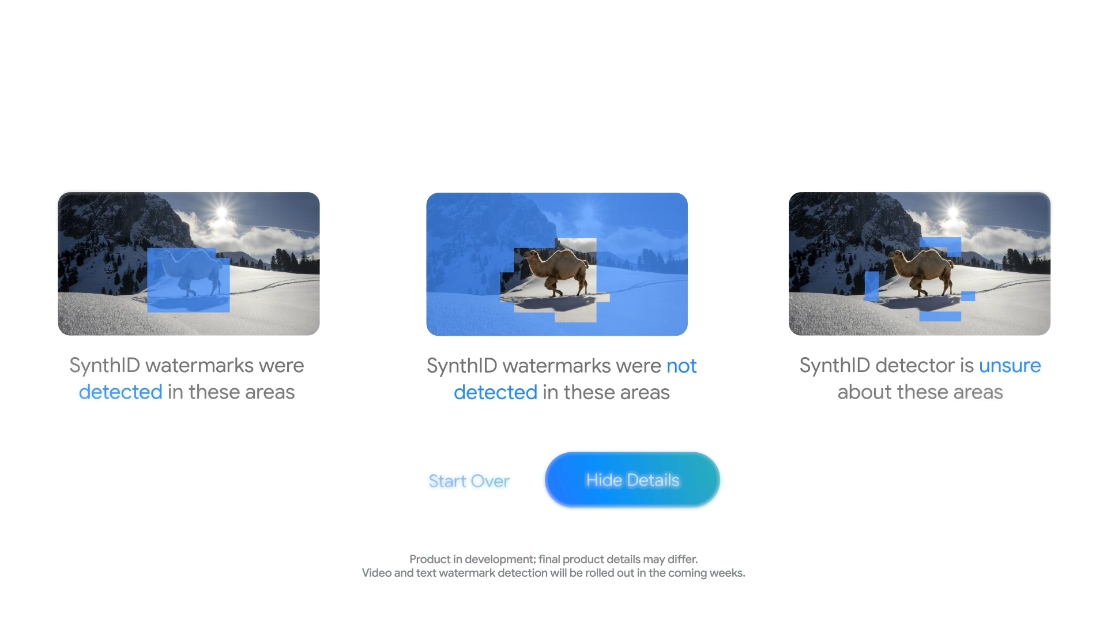
Google offers tools for checking whether content carries a SynthID watermark, including checks built into the Gemini app. But SynthID is Google's system, so it mainly identifies content made with Google's tools.
What Is C2PA?

C2PA stands for the Coalition for Content Provenance and Authenticity, an industry group whose members include Adobe, Microsoft, Google, OpenAI, and Sony. It created an open standard for what's usually called Content Credentials.
Content Credentials work like a tamper-evident record attached to a file. They can show which device or app created something, whether AI was involved, and what edits were made along the way. The record is cryptographically signed, so changes to it can be detected.
Unlike SynthID, C2PA isn't limited to AI. Cameras can attach Content Credentials to footage at the moment of capture, which helps prove something was actually filmed. Sony, for example, has extended its authenticity system to video for news and broadcast organizations.
How They Differ
The simplest way to think about it:
- SynthID is hidden inside the content. It's invisible, hard to remove, and mainly says "this was made with Google's AI."
- C2PA is a record attached to the content. It's more detailed, can describe a file's full history, and works for both AI and camera-captured media, but it's easier to lose.
They're designed to work together. Google applies both to some content. Voices cloned with its new Gemini text-to-speech models, for example, carry SynthID watermarks along with C2PA Content Credentials.
How Can You Tell If a Video Is AI-Generated?

There's no single foolproof check, but a few steps help:
- Check for Content Credentials. Tools like the Content Credentials verify site can read C2PA data from a file, if it's present.
- Use company verification tools. Several AI companies now offer their own checks. Google provides SynthID detection, and companies like Runway and fal offer pages for verifying content made with their tools.
- Look for platform labels. Platforms like YouTube increasingly label altered or synthetic content.
- Think about the source. Where a video came from, and who posted it first, still matters as much as any technical check.
The Big Limitation
The most important thing to know is that the absence of a watermark doesn't prove a video is real.
Not every AI tool applies SynthID or Content Credentials. C2PA data can be stripped when a file is re-exported, screen-recorded, or uploaded to a platform that removes metadata. And watermarks from one company generally can't be read by another company's tools.
There's also a newer gray area. As phones and cameras rely more on AI processing, even genuinely captured footage can involve significant reconstruction before the file is saved. Content Credentials record what device made a file and what edits happened afterward, but they don't necessarily describe how much processing happened inside the camera itself.
Why This Matters for Filmmakers
For filmmakers, these systems cut both ways.
On one side, they can help prove your work is authentic, especially for documentary, news, and nonfiction work where credibility matters.
On the other, if you use AI tools in your own productions, your footage may carry these markers whether you realize it or not. Knowing what's embedded in your files helps you disclose AI use accurately to clients, distributors, and festivals, which is increasingly expected.
Competitive Context
The industry is moving toward labeling, but it's still fragmented. Google leans heavily on SynthID, while C2PA has broad backing across tech, media, and camera companies. Individual AI platforms also run their own verification tools.
Until detection works reliably across every company's tools, no single check will catch everything.
The Signal in the Noise
SynthID and C2PA are genuinely useful, but they're best understood as evidence, not proof. A watermark or credential can confirm where something came from. A missing one tells you very little.
For now, the most reliable approach combines technical checks with good judgment about sources, which is what careful filmmakers and journalists have always done.
Have you started checking for Content Credentials on footage you use, or on your own work?
The Details
- SynthID: invisible watermark from Google DeepMind, embedded in AI-generated images, audio, video, and text
- C2PA: industry coalition behind Content Credentials, a signed record of a file's origin and edits
- C2PA members include: Adobe, Microsoft, Google, OpenAI, Sony
- Key difference: SynthID is hidden inside content; C2PA is a record attached to it
- Used together: Google applies both to some content, including cloned voices in Gemini TTS
- Ways to check: Content Credentials verify tools, company verification pages, platform labels, source checking
- Main limitation: no watermark doesn't mean no AI; credentials can be stripped, and systems don't all read each other