What Is Model Distillation? How AI Video Models Learn to Run in Fewer Steps
Model distillation trains fast AI video models to imitate slower ones in far fewer steps. Here's how it works, and what you trade for the speed.

AI video models have gotten dramatically faster this year. Clips that once took minutes now render in seconds, and some models can generate video faster than it plays back. One of the biggest reasons is a technique called model distillation.
If you've seen model names with words like Turbo, Flash, or Lightning, or read that a model now runs in "4 steps instead of 50," you've already run into it. Here's what distillation is, how it works, and what it means for filmmakers.
First, Why AI Video Is Slow
Most AI video models are diffusion models. They don't create a clip in one pass. They start from random noise and refine it over many steps, gradually turning static into a coherent video.
Each step requires running the full model, which is computationally expensive. A standard model like MiniMax H3 uses around 50 steps. More steps generally mean more refinement, but also more time and more cost.
What Is Model Distillation?
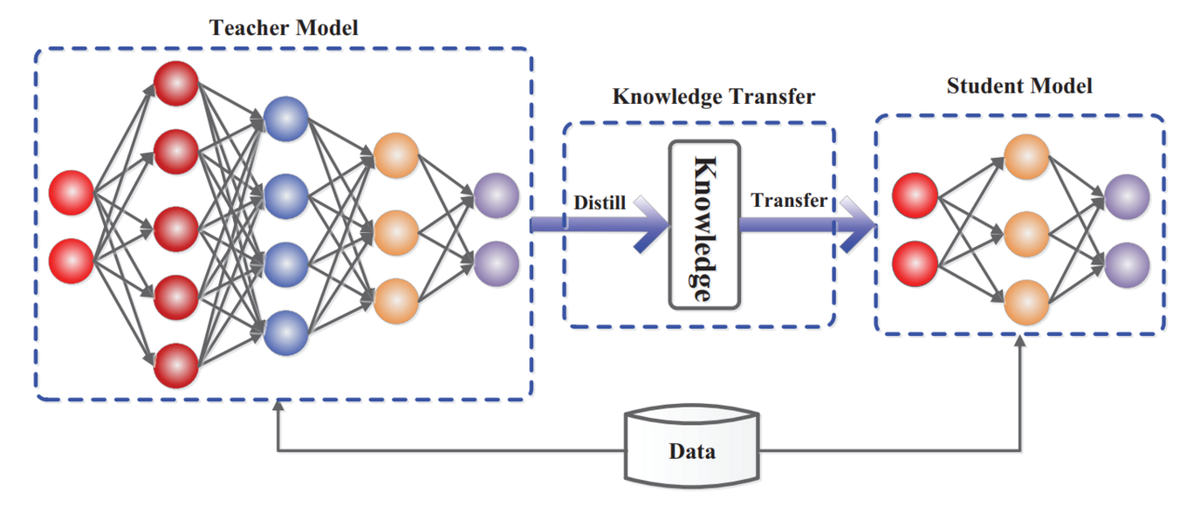
Model distillation trains a faster model to imitate a slower one.
It works like a teacher and a student. The teacher is the original, full-quality model that takes many steps. The student is trained to produce the teacher's results using far fewer steps, sometimes just four or eight.
The student doesn't have to learn video generation from scratch. It learns to skip ahead, reaching results close to what the teacher would produce after 50 steps in a fraction of the time.
The Two Main Kinds
Step distillation cuts the number of refinement steps. This is the "50 steps down to 4" type most speed announcements describe.
Guidance distillation removes a hidden cost. Many models run each step twice, once following your prompt and once without it, then compare the two to follow your instructions more closely. That technique is called classifier-free guidance. Guidance distillation trains the model to get the same effect in a single pass, roughly halving the work per step.
Many fast models use both.
Real Examples From the MiniMax H3 Ecosystem
The open-weight MiniMax H3 model has become a showcase for distillation, with several independent projects taking different approaches:
- FastH3 distilled H3's 50-step process down to 4, combined with other optimizations, for up to a 14x speedup on a single high-end GPU. It now runs locally on Apple Silicon and NVIDIA's DGX Spark.
- Alibaba's PDD method gets H3 generating in 8 or even 4 steps, without classifier-free guidance.
- LightX2V released 4-step and 8-step "Turbo" versions of H3, along with a free public playground to try them.
Black Forest Labs' FLUX 3 Action, a robotics model built on its FLUX 3 video training, offers a clear look at the tradeoffs. Guidance distillation made it roughly twice as fast with no loss in accuracy. Step distillation made it several times faster again, but at a measurable cost in task success.
The Tradeoff: Speed vs. Quality
Distillation is rarely free. Fewer steps means less room to refine details, and the effects show up in specific places:
- Complex motion can look less convincing
- Fine detail may come out softer
- Audio quality can drop in models that generate sound
- Variety between generations can narrow
FastH3's own developers noted that difficult motion, fine detail, and some audio quality can fall below the full base model. Community comparisons of competing H3 Turbo versions have found similar tradeoffs, with one version holding sharper detail and another producing better audio at the same step count.
The quality gap has been shrinking quickly, though, and for many uses the speed gain is well worth it.
Distillation Isn't the Only Speed Trick
Distillation often gets combined with other techniques that work differently:
- Sparse attention skips calculations that don't meaningfully affect the result. NVIDIA's Sol-H3 uses this approach.
- Architecture changes redesign how the model processes a clip. VDN rebuilt H3's attention system for faster generation.
- Quantization stores the model in lower precision, like FP8, so it runs faster on the same hardware.
When a model gets dramatically faster, it's usually a combination of several of these.
Why Filmmakers Should Care
Faster models change how you can actually work with AI video:
- Faster iteration. When a clip renders in seconds, you can try many variations and actually direct the result.
- Lower cost. Fewer steps means less computing, which usually means cheaper generation.
- Running locally. Distilled models can fit on consumer hardware, so you don't have to rent cloud GPUs.
- Real-time and interactive video. Continuous generation and interactive world models depend on video being generated as fast as it plays, which distillation helps make possible.
Competitive Context
Nearly every major AI video company now offers a faster, lighter version of its flagship model, often labeled Flash, Turbo, Lite, or Lightning. Many of those rely at least partly on distillation.
The pattern is becoming standard: release a high-quality model, then release a distilled version that trades a little quality for a big jump in speed and a lower price.
The Signal in the Noise
Model distillation is one of the main reasons AI video has moved from slow, expensive experiments toward something you can iterate with in real time. It doesn't make models smarter. It makes them faster, with a quality tradeoff that keeps getting smaller.
For filmmakers, the practical takeaway is simple: when you see Turbo, Flash, or a low step count, expect speed first and test whether the quality holds up for your specific shot.
Would you rather work with a slower model at full quality, or a faster one you can iterate with more freely?
The Details
- Model distillation: training a faster "student" model to imitate a slower "teacher" model
- Step distillation: reduces refinement steps, such as 50 down to 4
- Guidance distillation: removes the extra pass required by classifier-free guidance
- H3 examples: FastH3 (50 to 4 steps, up to 14x faster), Alibaba PDD (8 or 4 steps), LightX2V (4- and 8-step Turbo)
- Common tradeoffs: complex motion, fine detail, audio quality, variety
- Related speed techniques: sparse attention, architecture changes, quantization
- Common labels: Turbo, Flash, Lite, Lightning
Resources & Reads
- BRC: FastH3 Is a 14x Faster MiniMax H3 You Can Now Run on a Mac
- BRC: PDD Isn't a Normal LoRA, Here's How Alibaba Sped Up MiniMax H3
- BRC: You Can Try Accelerated MiniMax H3 for Free Right Now, No Install Needed
- BRC: VDN Rebuilds MiniMax H3's Attention Instead of Just Speeding It Up
- BRC: The State of MiniMax H3: A Complete Guide to the Ecosystem Built Around It